






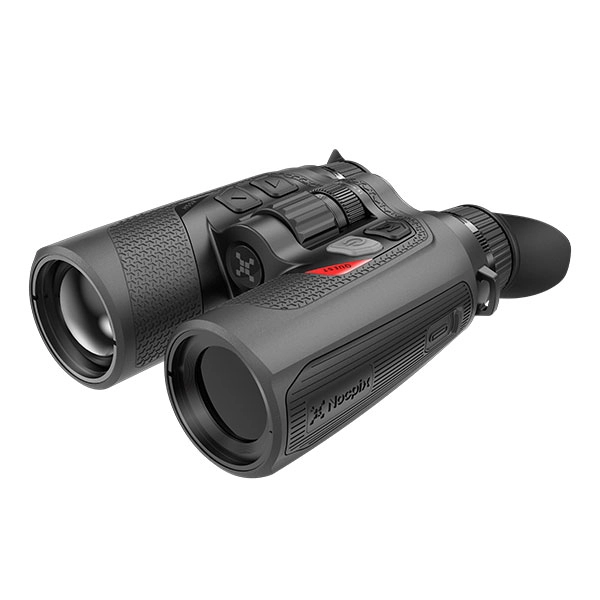
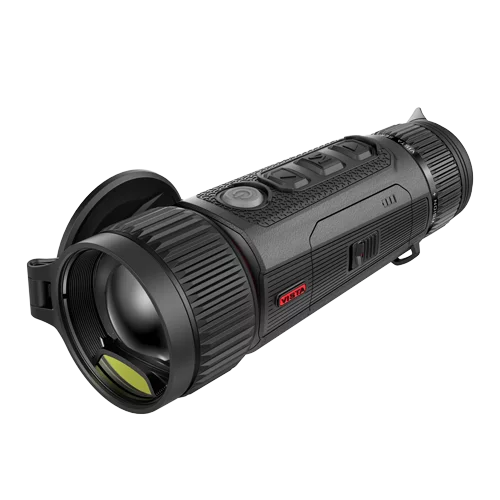
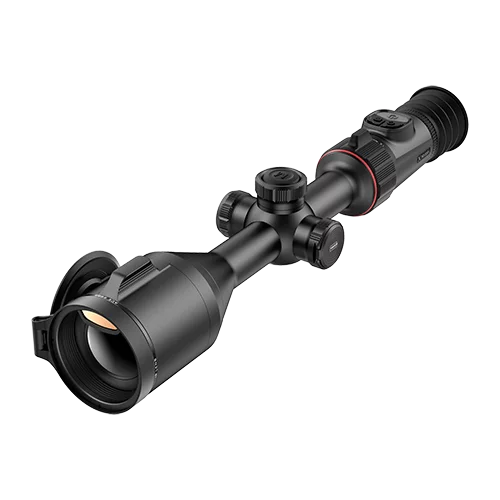
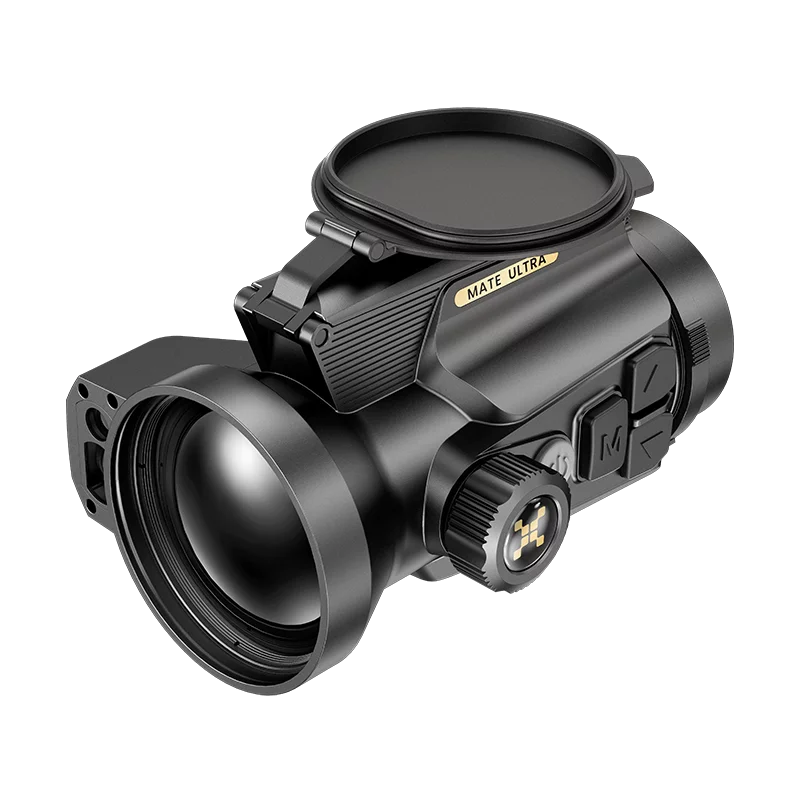
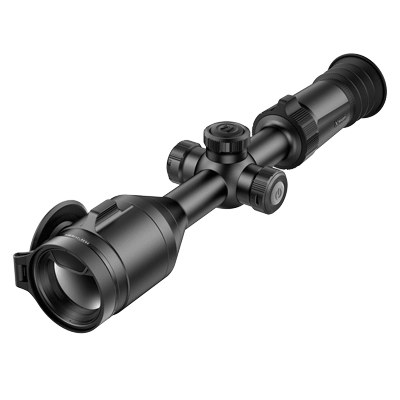


In a 35mm vs 50mm thermal scope comparison, choose 35mm for a wider view and faster target acquisition. Choose 50mm when open terrain and distant target detail outweigh the need to see more of the scene.
Picture a hog entering a field edge at 60 yards. A wider 35mm view makes it easier to find and follow as it moves past brush. Now put a coyote several hundred yards across an open field. On the same detector, a 50mm lens spreads that smaller target across more pixels, which can support recognition at distance.
The lens number alone does not settle the purchase. Sensor resolution, pixel pitch, F-number, field of view, base magnification, focus, and image processing can change the result. Compare complete specifications before treating one model as better.
Quick Answer: Should You Choose a 35mm or 50mm Thermal Scope?
Use this table as a starting direction, then check the complete imaging system.
| Hunting situation | Better starting direction | Why | Main limitation |
| Woods, brush, or short lanes | 35mm | Wider view and faster acquisition | Less target sampling at distance on the same sensor |
| Mixed terrain | 35mm | More forgiving when distances change | May need more digital enlargement at the far end |
| Open fields and long lanes | 50mm | More detector pixels across a distant target | Narrower search window |
| One device used to scan and aim | 35mm | Easier to cover ground without sweeping as much | Less specialized for distant recognition |
| Rifle optic paired with a handheld scanner | 50mm | Scanner handles the wide search; scope handles the tighter view | Two-device workflow and added cost |
What Does 35mm vs 50mm Change on a Thermal Scope?
The 35mm and 50mm labels describe objective-lens focal length. They do not describe detector resolution, physical lens diameter, digital zoom, or guaranteed shooting range.
Focal Length Changes the Scene Projected Onto the Detector
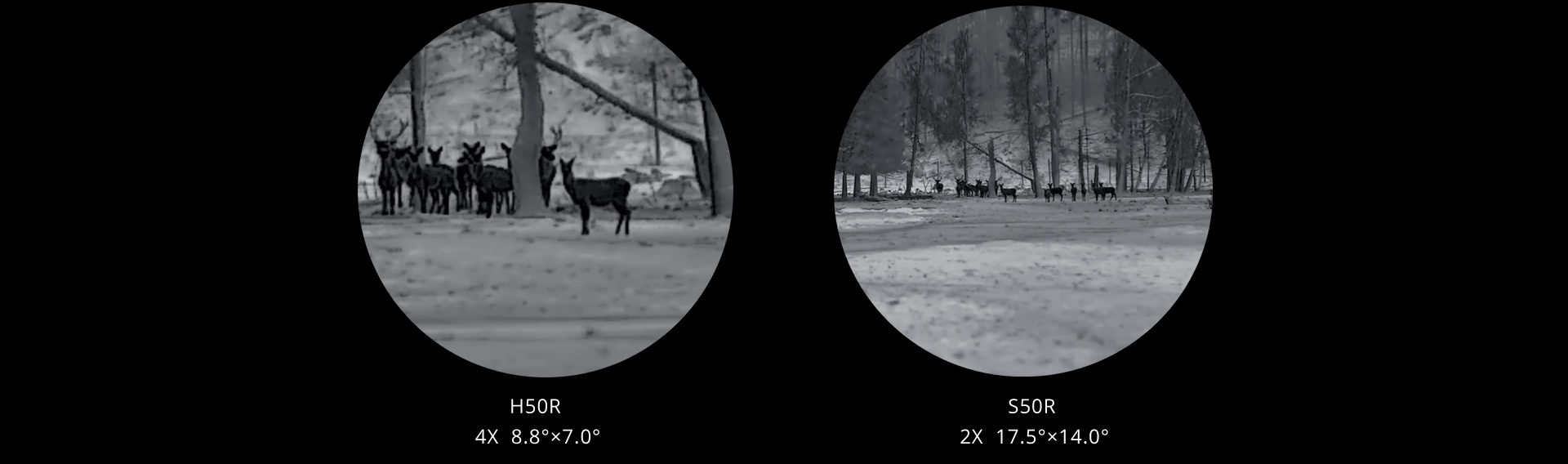
A shorter focal length shows a wider angular scene on the same detector. A longer focal length shows a narrower part of that scene, so a target occupies more detector pixels at the same distance.
A longer focal length narrows the field of view and tightens the instantaneous field of view, or IFOV—the angle each detector pixel covers. A distant object therefore occupies more pixels in the image. A shorter focal length covers more area but gives each object fewer pixels.
This is the basic tradeoff behind the choice: scene coverage versus angular detail.
A Matched 640×512, 12µm Comparison
The cleanest comparison holds the detector constant. The table below uses a 640-pixel-wide detector with 12µm pixel pitch and ideal geometric calculations. Listed product specifications may vary slightly because of image cropping, optical design, and display format.
| Matched-system measure | 35mm lens | 50mm lens |
| Approx. horizontal FOV | 12.5° | 8.8° |
| Approx. scene width at 100m | 21.9m | 15.4m |
| Approx. IFOV | 0.343 mrad/pixel | 0.240 mrad/pixel |
| Approx. scene width per pixel at 100m | 34mm | 24mm |
| Relative pixels across the same target | 1.00× | 1.43× |
The 50mm lens places about 43% more pixels across the same target dimension than the 35mm lens because 50 ÷ 35 is about 1.43. That does not mean the final image is automatically 43% better. Lens quality, focus, NETD, processing, atmospheric loss, target contrast, and motion still influence what the hunter sees.
The FOV cost is easy to feel. At 100m, the matched 35mm system shows about 6.5m more horizontal scene width. That extra space can keep a moving animal in the image or help the shooter recover it after recoil.
F-Number Is Not the Same as Focal Length
Focal length controls framing and angular sampling. F-number is focal length divided by the entrance-pupil diameter and is one part of the thermal signal path. A 50mm F1.0 lens has a larger entrance pupil than a 35mm F1.0 lens. It is not automatically more sensitive than every 35mm scope.
Compare F-number, detector sensitivity, optical transmission, calibration, focus, and processing together. “50mm” by itself is not an image-quality grade.
Which Lens Fits Your Terrain and Target Behavior?
Terrain determines whether field of view or distant target sampling has more value. Regular conditions should drive the purchase; an unusual longest shot should not dictate every night behind the scope.
Choose 35mm for Woods, Brush, and Fast Target Acquisition
A 35mm thermal scope is usually the better fit for woods, brush, small fields, and animals that appear at changing distances. The wider view shows more surrounding terrain, which helps the shooter acquire a target without making large rifle movements.
That extra view is useful when an animal crosses between trees, enters from an unexpected side, or moves with a group. It also helps after recoil because the shooter has more room to find the target again.
A wider view does not remove the need for positive identification. Brush can hide legs, head shape, or animals behind the intended target. The scope may show heat through gaps in vegetation, but it does not see through solid cover. If the target cannot be identified and the background cannot be confirmed, the shot is not ready.
The 35mm limitation appears as distance grows. On an otherwise matched detector, a small animal occupies fewer pixels than it would behind a 50mm lens. Digital zoom can make the animal look larger on the display, but it cannot restore detail that was never sampled.
Choose 50mm for Open Fields and Deliberate Distant Recognition
A 50mm thermal scope fits open farmland, prairie, broad calling areas, and other places where the target is often found at distance. The tighter view places more detector pixels across the target, supporting shape and movement assessment before digital enlargement.
This advantage is most useful when the long lane is normal. If nearly every stand begins with a wide scan and ends with a distant target, the tighter 50mm image can be worth the loss in scene width. A stable rest also helps because small rifle movements shift a narrow view farther across the landscape.
The main limitation is acquisition. An animal that appears close may fill the screen quickly or enter outside the current view. Tracking a group of hogs can also be harder because fewer animals fit in the frame. A 50mm model may be larger, heavier, or more expensive than a related 35mm model, although product design matters more than the focal-length number alone.
Do not use the listed detection range as a shooting limit. Detection means that a heat source is visible. Recognition and identification require more target information. Weather, target size, partial cover, focus, and background temperature can shorten usable range on any lens.
Use 35mm as the Mixed-Terrain Default—Unless Distance Dominates
When one rifle must cover timber, field edges, pastures, and occasional longer lanes, 35mm is the safer starting direction. The wider view is useful on every close encounter, while digital zoom remains available for inspection. The tradeoff is accepting less native target sampling at the far end.
Move to 50mm when three conditions line up:
- Long Lanes Are Routine: The hunt repeatedly presents distant targets rather than one rare opportunity.
- The Target Is Found Before Aiming: A partner or handheld device locates the animal, so the riflescope does not carry the full scanning job.
- The Shooting Position Is Stable: A rest, tripod, or supported position makes the tighter view easier to control.
Many predator hunters separate scanning from aiming. A handheld device can search with a wider view while the rifle stays pointed safely. This guide to choosing a thermal scanner for coyote hunting explains when that two-device setup is useful.
If the riflescope must do both jobs, prioritize acquisition. A few extra seconds spent searching through a tight view can erase the distant-detail advantage before the target ever reaches the reticle.
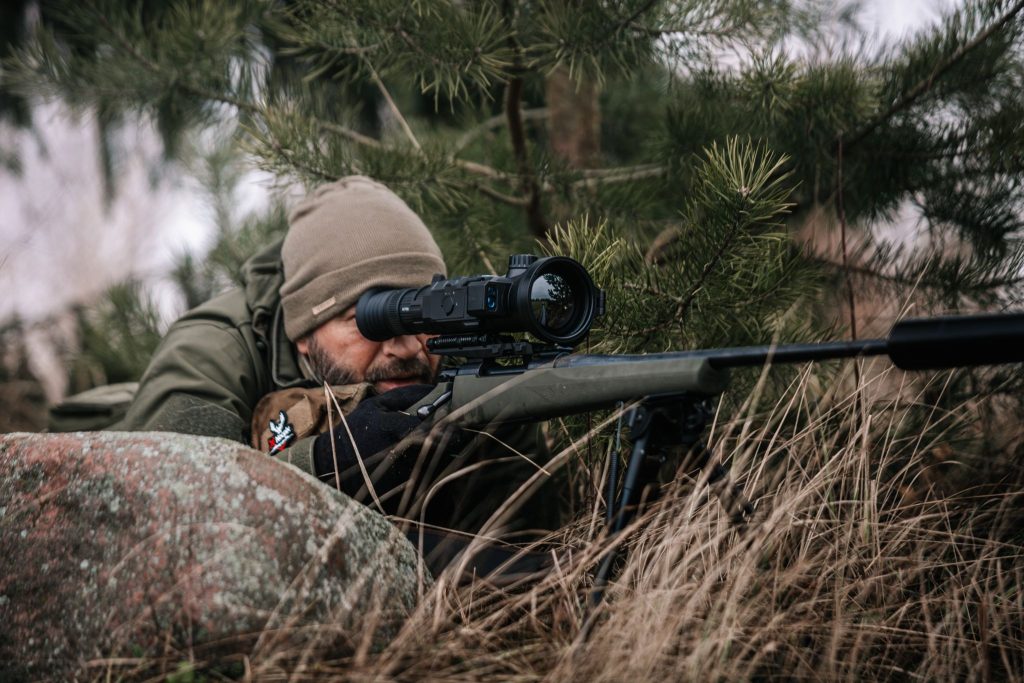
How Do You Compare Complete Thermal Systems Fairly?
Compare 35mm and 50mm lenses only after normalizing the detector and optical specifications. A product called “35-640” and one called “50-384” change two major variables at once, so the better choice cannot be read from the lens label.
Compare These Eight Specifications in Order
Use the following order to keep the comparison tied to image information and field use.
- Detector Resolution and Aspect Ratio: A 640×512 detector records more total scene samples than a 384×288 detector. On the same focal length and pixel pitch, it also covers a wider angular scene.
- Pixel Pitch: Smaller pitch places detector samples closer together. For a quick comparison, divide pixel pitch by focal length. A lower result means finer angular sampling per pixel.
- Focal Length: Compare 35mm and 50mm after the first two values are known. Longer focal length gives tighter sampling; shorter focal length gives more scene.
- F-Number and Sensitivity: Check F-number, NETD test conditions, and any verified image-processing information. Do not treat unlike NETD claims as laboratory-equivalent unless the test conditions match.
- Listed Field of View: Compare both degrees and width at 100m or 100 yards. FOV is the most useful specification for predicting how hard a target will be to find and follow.
- Base Magnification, Display, and Eyepiece: Base magnification describes the apparent view at the eye, but display size and eyepiece design can change that appearance. Use listed FOV to judge scene coverage instead of inferring it from magnification alone.
- Minimum Focus Distance: Check the nearest distance at which the lens can form a sharp image. This specification can decide whether a scope works around barns, sheds, and other close property settings. A wide enough view does not help if the target sits inside the lens’s focusing limit.
- Recognition Evidence: Look for full-resolution footage or field tests involving similar animal size, distance, weather, and vegetation. Detection figures alone do not answer whether enough shape remains for the intended decision.
This order explains why a 640×512 35mm scope can be better for some hunters than a 384×288 50mm scope. The 640/35 system can show a much wider scene with more total image samples. The 384/50 system may place a given target across more pixels than its lower resolution suggests because its pixel pitch and focal length tighten angular sampling. Calculate or compare the actual FOV instead of assuming “640 wins” or “50mm wins.”
If lens size is only one part of the purchase, the full guide on how to choose a thermal scope covers battery life, controls, mounting, rangefinding, and other system-level factors. If price is the next filter, compare what buyers receive from a thermal scope for the money. Avoid paying for a focal length that does not fit the terrain.
Digital Zoom Does Not Replace Native Optical Sampling
Applying 2× digital zoom to a 35mm image crops the frame and enlarges the remaining pixels. It does not change the lens, IFOV, or number of detector samples originally placed across the target.
Digital zoom can still help the eye inspect an image, especially on a high-resolution detector. It just cannot make a 35mm optical system identical to a matched 50mm system. The longer lens starts with a tighter view before the image reaches the display.
How 35mm and 50mm Fit the Nocpix Riflescope Lineup
Nocpix offers both focal-length routes, but the models also change sensors and platforms. Treat them as examples of complete configurations, not as a controlled lens-only test.
The 35mm Route
Both Nocpix 35mm scopes pair the focal length with a 384×288, 12µm detector, which produces a tighter view than a 640-class detector would behind the same lens. That detail shows why “35mm means wide” is only a relative rule—detector width has to stay in the sentence.
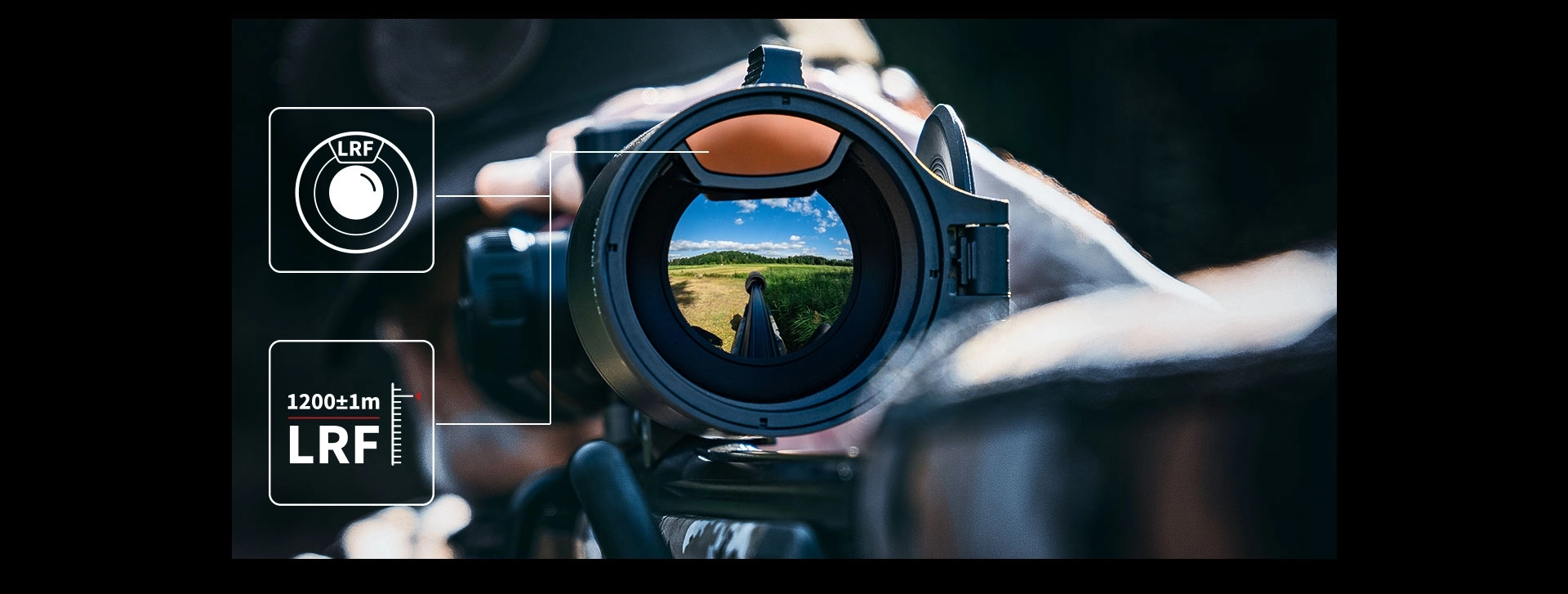
Within the 35mm route, the choice is about workflow rather than optics. The BOLT L35R adds an integrated rangefinder and ballistic calculation, suiting hunters who want ranging and aiming in one device. The ACE L35 drops the rangefinder but gains a faster F0.9 lens on the ACE platform, fitting buyers who prioritize image brightness and the ACE control layout over onboard ballistics.
The 50mm Route
All three Nocpix 50mm models pair the lens with a 640×512, 12µm detector, so image sampling is essentially shared. The decision between them is platform-level: the ACE H50 and H50R serve hunters who want the ACE body and controls, with the H50R adding an integrated rangefinder, while the RICO 2 H50R suits shooters who prefer the RICO 2 platform’s design and feature set.
These 50mm models fit hunters whose terrain regularly presents distant targets and who want a 640-class image behind the tighter view. Because the sensor and lens are matched across the three, focal length should not be the reason to choose between them—body, controls, and rangefinding should be.
Frequently Asked Questions About 35mm vs 50mm Thermal Scopes
Is a 35mm thermal scope enough for coyote hunting?
Yes, when its sensor, pixel pitch, image quality, and FOV support the distances and terrain involved. A 35mm lens is often useful in mixed terrain because it balances acquisition and distance. Open-country hunters who regularly need smaller targets to occupy more pixels may prefer 50mm.
Can you use a 50mm thermal scope as a close-range spotter?
Yes, but it is usually better for inspecting a stationary target after it has been found than for searching a tight space. Check the scope’s actual field of view, base magnification, and minimum focus distance at the ranges you expect to use. A 50mm view can feel restrictive in a barn even when the target is not being shot through the optic. If close-range scanning is the primary job, a lower-magnification 35mm scope or wider handheld thermal is usually easier to use.
Does 2× digital zoom make a 35mm scope equal to a 50mm scope?
No. Digital zoom crops and enlarges existing pixels. It may make the display easier to inspect, but it does not improve IFOV or add the native target samples produced by a longer lens on the same detector.
Is a 640×512 35mm scope better than a 384×288 50mm scope?
Neither is universally better. The 640/35 configuration usually provides more total scene information and a wider view. The 384/50 configuration may provide tighter angular sampling and higher apparent base magnification. Compare pixel pitch, FOV, sensitivity, optics, and recognition evidence for the actual models.
Final Recommendation
Choose 35mm when the hunt rewards a wider view, quick acquisition, and flexibility across changing distances. Choose 50mm when open ground and regular distant recognition justify a tighter window.
Before buying, write down the regular target distance, terrain, target size, and whether a separate scanner will handle the search. Then compare complete Nocpix configurations or ask an authorized dealer to match those needs to the appropriate riflescope.
Thermal hunting rules vary by location, species, and season. Confirm current local requirements before field use.