


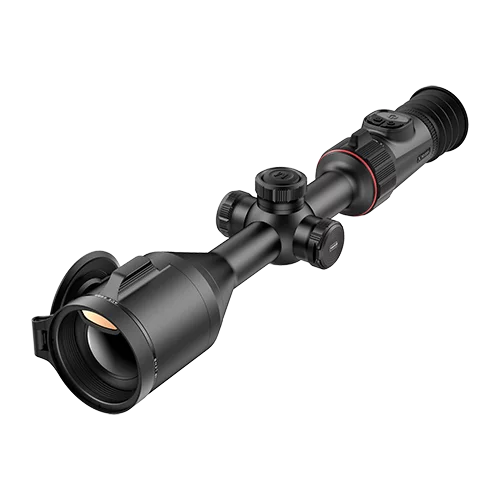
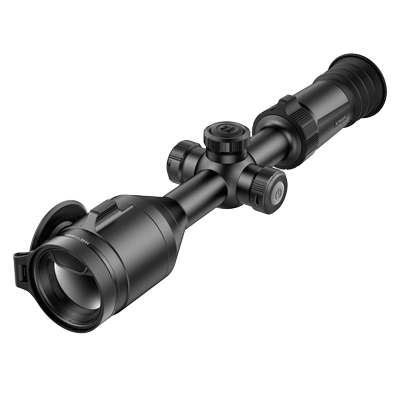


ACE 2 offers a more complete set of features for most hunters. The original ACE already delivers strong thermal imaging, a traditional tube-style design, Ocular Zoom, and an integrated laser rangefinder on its R models. With ACE 2, we kept that foundation and redesigned the parts a hunter touches repeatedly: the rifle carries less weight, focus moves under the shooting hand, the eye box is more forgiving, zoom takes less thought, and the rangefinder responds more quickly.
That is the real generational change. ACE 2 is about more than higher numbers on a specification sheet.. It is designed to remove small delays and unnecessary movement between detection, identification, ranging, and a responsible shooting decision.
| Hunting moment | ACE | ACE 2 |
|---|---|---|
| Carrying and shouldering the rifle | Heavier, especially in S60R form | A lighter magnesium body improves rifle balance and repeated handling |
| Finding focus | The forward objective control can require a longer reach | Central focus stays close to the shooting hand |
| Magnifying the target | Optical and digital magnification require more deliberate coordination | Ocular Zoom 2.0 blends the two into one more natural control |
| Finding the full display | A capable but tighter eye position | More eye relief and a larger exit pupil give the head more room |
| Ranging during a short pause | The same published maximum distance, with the original control experience | Faster response and more control over the ranging display |
| Following movement | Smooth 60 Hz imaging was already a strength | Refined controls help the hunter stay with the animal; S60R adds Motion and Still modes |
Target identification improves most when the background is difficult
A warm animal on a cold, open field is an easy thermal scene. The harder work starts when a fox pauses against a hedge, a wild boar moves through crop residue, or a deer stands partly behind uneven vegetation. The hunter needs more than a bright target. Leg position, body shape, movement, the ground around the animal, and anything crossing the intended line all contribute to the decision.
ACE remains a strong performer in these scenes. Its 640 and 1280 sensor options, fast lenses, 60 Hz imaging, and Reality+ processing established the series as a capable hunting platform. A hunter moving from an unrelated lower-resolution or older thermal scope may find the original ACE a major step forward in its own right.
ACE 2 builds on that foundation. Its updated detector and R+ 2.0 processing retain small temperature differences and suppress distracting noise when the animal blends into the background. The purpose is not cosmetic sharpness. It is to keep the outline of the animal, the structure of the ground, and possible obstructions readable in the same view. This is useful when controlling wild boar in fields with crop residue, observing a fox against a hedge, or assessing an animal partly obscured by vegetation. Hunters building a setup around that use can go deeper in our guide to choosing a thermal scope for hog hunting.
The improvement will not look equally dramatic every night. Temperature, humidity, palette, focus, and the amount of time the ground has had to cool can narrow or widen the visible difference between generations. For the hunter, the useful question is whether the scope holds enough animal shape and background detail at the distances and in the weather that usually produce uncertainty.
Independent field use supports that conclusion. A direct ACE-versus-ACE 2 comparison found the two generations relatively close in favourable scenes but judged the ACE 2 handling changes more significant in practice. A separate S60R test in British farm country reported useful animal and ground detail at distance. That is useful confirmation of what the redesign was intended to achieve.
ACE 2 gives more room in those difficult scenes. It does not turn initial detection into automatic identification. A heat source still needs to become the right animal, in a clear position, with enough surrounding information to act.
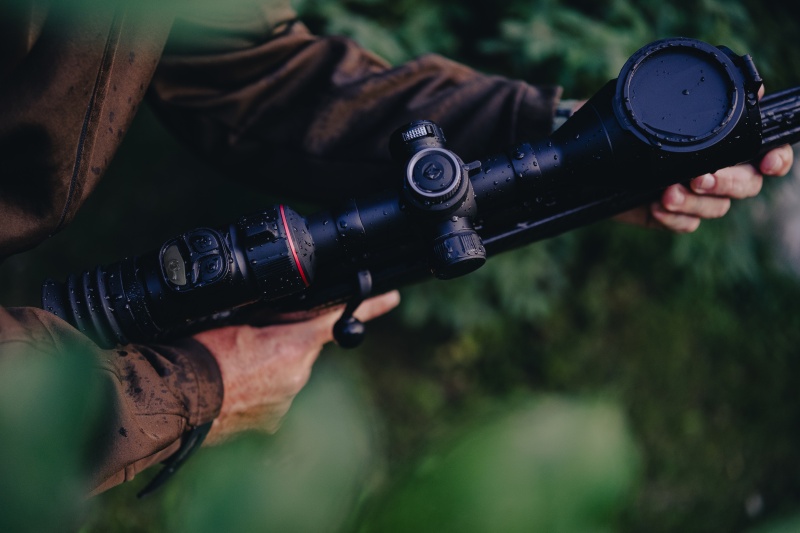
Moving animals reward simpler controls
An animal rarely waits while the hunter works through a menu. A fox crossing stubble, a boar leaving standing crop, or a coyote angling toward a call may offer only a short stretch of unobstructed ground. The scope has to support three actions without breaking the picture: follow the animal, adjust the image, and settle at the required magnification.
The original ACE already delivers smooth imaging, with a 60 Hz frame rate on the H50R and 50 Hz on the S60R. And its optical eyepiece magnification preserves more of the display quality than digital zoom alone. The tradeoff is that optical and digital zoom can feel like two separate decisions. At higher optical eyepiece magnification, some UI information near the edges of the display may no longer be fully visible, and the reticle also appears thicker.
Our Ocular Zoom 2.0 system combines optical and digital magnification through the eyepiece ring. Reticle and interface elements remain visible as the image grows, so the hunter can stay on the animal while using one control. That reduction in mental and physical steps is more useful in a moving encounter than another maximum-magnification number.
The ACE 2 S60R goes further with two viewing modes. Motion mode keeps the 60 Hz response for animals on the move. Still mode uses a lower frame rate to draw more detail from a stationary target and the surrounding ground. Motion belongs with an animal that is still travelling; Still becomes useful when the animal stops and the hunter has time to study shape, position, or intervening cover. Conditions still matter, but the hunter can now choose whether immediacy or fine scene detail has priority.
The ACE 2 H50R operates at 60 Hz, providing smooth imaging for fox, coyote and wild boar hunting at typical field distances.
ACE 2 asks for less movement behind the rifle
The central focus control may be the most field-relevant redesign in the new series. On the original ACE, focusing means reaching toward the objective. From a stable bench that is a small action. From sticks, a high seat, a vehicle window, or an improvised position, the reach can move the rifle and interrupt a settled cheek weld.
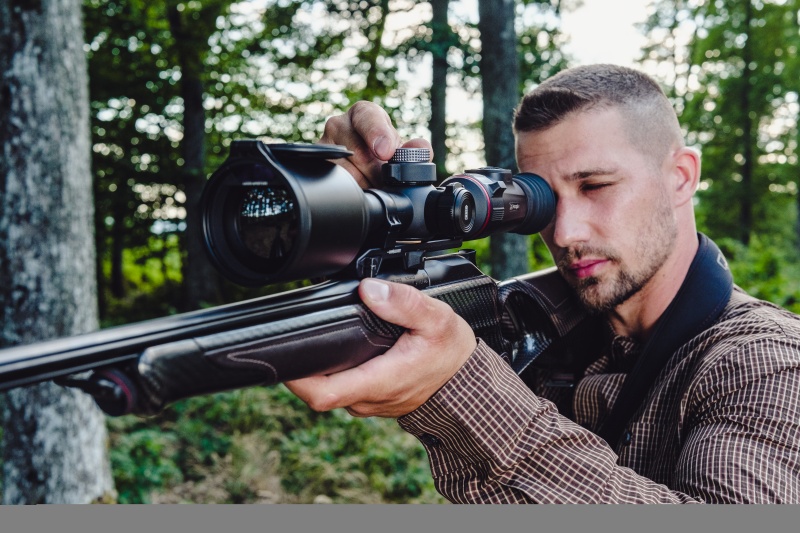
The ACE 2 Central Focus System around the top turret, close to the hand already operating the scope. A hunter can sharpen the animal or the foreground while keeping the rifle supported and the eye near the display. The control is also naturally ambidextrous.
The viewing position is more forgiving as well. ACE 2 increases eye relief from 50 mm to 60 mm and exit pupil diameter from 8 mm to 10 mm. Those numbers matter because field positions are rarely identical. A thick jacket, a slightly different shoulder pocket, an angled seat, or a set of sticks at the wrong height can move the head away from its perfect position. The larger eye box makes the full circular display easier to recover without searching with the head. Mount position still shapes that experience, so the scope should be set up around the shooter’s natural shoulder position rather than forced into an arbitrary ring location; our thermal scope mounting guide explains the checks that matter.
Weight completes the handling change. ACE 2 H50R removes 200 g from the published device weight, while S60R removes 320 g. We made that reduction because weight above the action affects more than the walk to the stand. It changes how quickly the rifle comes up, how long it can be held ready, and how much effort is required to keep it stable while an animal moves behind cover. The S60R reduction is larger still and directly addresses one of the strongest practical objections to the original flagship.
The effect depends on the whole rifle. A heavy barrel, mount position, stock, sling, and attached accessories set the balance point. On a fixed high-seat rifle, the reduction may feel modest. During walking fox control or repeated vehicle exits, less weight above the action is easier to appreciate.
Faster ranging matters more than a longer headline distance
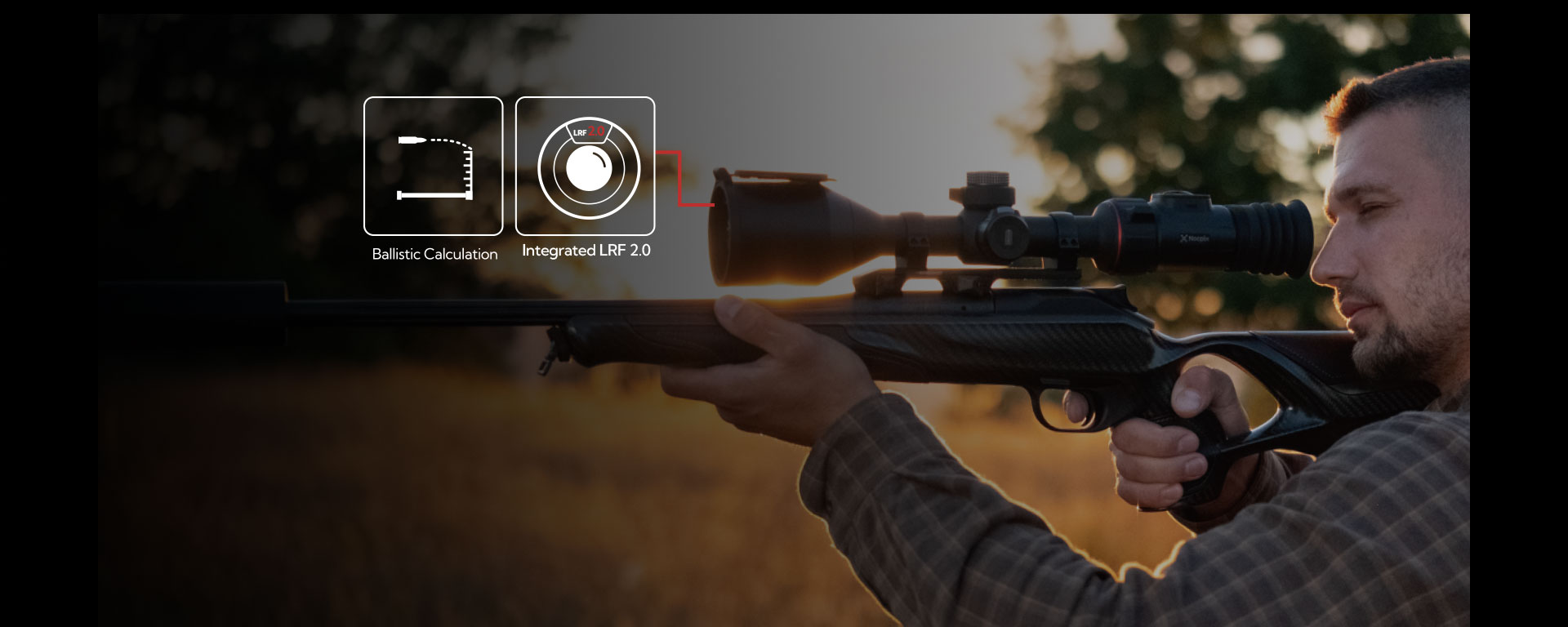
Both generations publish the same maximum laser rangefinder distance of 1,200 metres on comparable R models. ACE 2 gains its field advantage through how quickly and cleanly the hunter can obtain a useful reading. The redesigned LRF responds faster, while controls for the ranging mark, colour, brightness, and display duration help keep information from obscuring the aiming area.
The practical moment is usually much shorter than the published maximum. An animal pauses near a field edge. The hunter needs distance before it moves again, without losing the body in the picture or filling the centre of the display with extra information. Faster response and better control of the ranging overlay make ACE 2 feel more prepared for that moment.
The original ACE rangefinder remains fully useful when it already returns stable readings on the ground and targets a hunter normally encounters. ACE 2 becomes more persuasive where delayed readings, display clutter, or repeated ranging attempts have been a regular frustration. For hunters deciding whether integrated ranging belongs on the rifle at all, our LRF thermal scope guide covers the tradeoffs beyond maximum distance.
A full night still depends on power planning
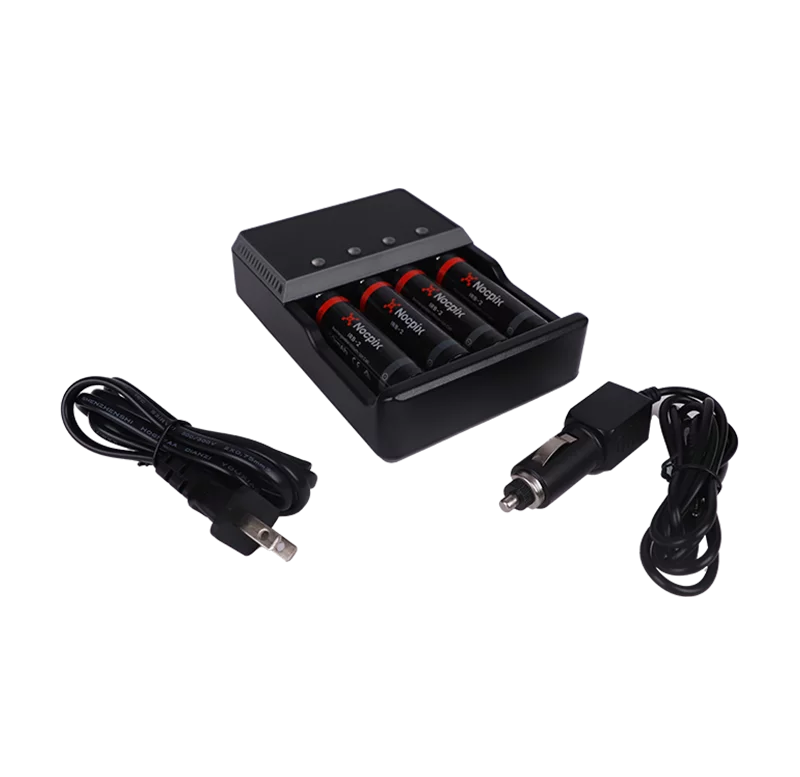
ACE and ACE 2 both combine an internal battery with a removable 18650 cell, so a fresh battery can extend a session without connecting the rifle to a power bank. That hybrid power architecture is deliberate: the built-in cell keeps the scope self-contained, while the replaceable cell gives the hunter a practical way to carry more operating time.
Published runtime is a planning reference, not a promise for every night. Cold weather, display brightness, Wi-Fi, recording, and repeated ranging can shorten the result. A charged spare 18650 still belongs in the kit for an all-night control job, and the battery display should guide the plan instead of an assumption that laboratory runtime will be reproduced in every field condition.
Intelligent Tracking adds a different kind of field help. It can record the direction and measured distance of a marked point and guide the hunter back through the app. Its role is orientation and recovery support; it does not replace marking the location, reading the animal’s reaction, and following an established tracking procedure.
H50R and S60R suit different hunting ground
The H50R remains the broadest fit in both generations. Its 50 mm lens and 640 sensor provide a useful balance of identification detail, field of view, and rifle weight for common fox, coyote, and wild boar distances. It is the model we would point most mixed-ground hunters toward first, because it does not demand that every outing look like an open-country, maximum-distance problem.
ACE 2 H50R strengthens that all-round role. The lighter body matters during mobile hunting, and the central focus and hybrid zoom help when the animal appears at an unexpected distance. A hunter working mixed pasture, field margins, hedgerows, or farm tracks will usually gain more from that faster handling than from moving to the largest sensor.
S60R is the stronger choice when open ground and identification distance dominate. Its 1280 sensor supports a wider field of view than many hunters expect from a 60 mm thermal scope, while preserving more shape as magnification increases. Dual Clarity gives it a useful split between moving animals and detailed observation from a fixed position. This is the model for hunters who will genuinely use the extra scene information, not simply the buyer who wants the largest number in the range.
The shorter-lens end of the two series requires a role-based comparison. ACE L35 and ACE 2 H35R both suit closer-range work, but they differ in sensor class and integrated features. Hunters working woodland, brush, or short fields should choose the wider-view role on its own merits; H35R is more than a like-for-like replacement. Our 35mm vs 50mm thermal scope comparison explains how lens choice changes field of view, base magnification, and the kind of ground each scope naturally suits.
When the original ACE is still the right choice
The original ACE remains a strong buy when the price difference is meaningful and the scope will be used mainly from a fixed stand, supported vehicle position, or another setup where its extra weight matters less. It also makes sense as a second-rifle scope for hunters who already know its controls and do not need to change focus repeatedly between near cover and distant ground.
There is no reason for a satisfied ACE owner to replace a scope that already balances well on the rifle, gives a full view as soon as it reaches the shoulder, and ranges reliably at normal hunting distances. The case for ACE 2 becomes stronger when the rifle is carried for hours, animals appear at changing distances, or ranging and focus adjustments regularly have to be made during short opportunities.
The verdict
The original ACE remains a capable, proven thermal scope, especially when value is the priority and its weight and control layout suit the rifle. ACE 2 is the stronger all-round choice for most new buyers and for ACE owners who regularly carry the rifle, change focus, track moving animals, or range during brief pauses.
ACE 2 combines improved imaging in challenging conditions with a lighter body, the Central Focus System, a more forgiving eyebox, Ocular Zoom 2.0, and Integrated LRF 2.0. It is not simply a newer ACE. It is a more complete thermal hunting system.
Explore the current ACE 2 thermal riflescope lineup to compare H35R, H50R, and S60R.