








A fox slips through a hedge gap just after the caller goes quiet. It is close and already angling toward the lower end of the field. If your thermal is zoomed into the far boundary, the chance may be gone before you identify it.
A sound foxing setup starts before the first call:
- Walk the ground in daylight and mark the likely cover exits.
- Enter without carrying your scent through the field or hedge you expect to watch.
- Set the caller and your position so the downwind side remains visible.
- Scan the whole stand before making a sound.
- Start quietly, pause, and scan the same fox-sized openings again.
- Use a handheld thermal to find and follow the animal; move to a lawful aiming device only after identification and a complete background check.
Sound and timing change with the ground, weather, season, fox pressure, and law. Keep the sequence simple enough to repeat without taking your attention off the field.
How Do You Set Up for Fox Hunting at Night?
Scout Travel Lanes and Cover Exits in Daylight
Begin with the places where a fox can leave cover without spending long in the open: hedge gaps, gateways, ditch ends, wall ends, field corners, farm tracks, woodland rides, and the margins between grass and crop.
GPS tracking in southern Norway found foxes sometimes following forest edges and roads after reaching them. On a night stand, that makes openings and transitions worth checking before the middle of the field—but it does not make every hedge a fox route. See the red-fox tracking study for the research context.
Also mark livestock, buildings, roads, public paths, hidden hollows, and every unacceptable direction. Check what a wall, bank, or wet grass hides from the intended position.
Plan the Approach Before Choosing the Exact Stand
The best viewpoint is poor if reaching it means walking along the hedge you intend to watch. Plan the vehicle, gate, and approach to keep noise and scent out of that ground.
Set the tripod or sticks, rifle, caller control, and scanner before calling. Keep the caller, nearest cover exit, visible downwind lane, and safe field of fire within one layout that needs little movement.
In a small hedged field, a modest view of three useful gaps is often more valuable than a high point that exposes your outline or hides the lower downwind corner.
How Should You Work the Wind on a Fox Stand?
Keep the Downwind Side Visible
Facing into the wind can work, but it is not the whole plan. A crosswind or quartering wind is often more useful when it carries scent away from the main cover and leaves the caller’s downwind side visible. If your scent runs into the hedge, ditch, or woodland block you expect to hold a fox, the setup is weak regardless of the call.
BASC fox-control guidance recommends considering wind, maintaining a wide view, and using into-wind or crosswind setups. A fox may work downwind, so cover that lane without assuming a complete circle.
Put the Caller Where It Helps the Setup
A remote caller moves the centre of attention away from the hunter. Place it where a fox can enter a safe, visible area without being drawn toward a road, building, livestock, or unseen hollow. Spacing depends on remote range, cover, field size, downwind visibility, and safe direction.
With a mouth call, sound and hunter stay together. Stillness, background cover, and a wide view matter more. Support the rifle and ready the scanner before the first note.
Know When a Wind Shift Spoils the Stand
Recheck the wind if it becomes gusty or curls around a bank, wall, or woodland edge. If scent repeatedly enters the main cover or an unseen approach, change the angle or move before a fox appears.
How Do You Call Foxes at Night?
Choose a Sound for the Ground
Prey distress is a common starting category. Rabbit distress can add reach across open ground; rodent or squeaking sounds suit close coaxing around field edges. Fox barks and other social sounds are more situational and should only be used where season, local experience, and law support them. Choose one sensible opening sound instead of changing tracks whenever nothing appears.
An electronic caller offers remote placement. A mouth call is immediate and easy to soften but keeps attention on the hunter. Neither fixes poor wind or a hidden downwind side.
Use a Simple Call-and-Scan Sequence
Start with a silent scan of the caller, nearest gaps and ditch ends, visible downwind edge, margins, and open ground. A fox may already be close.
Then use a simple first cycle:
- Begin softly.
- Make a brief calling series.
- Stop and scan rather than operating menus or immediately changing sounds.
- Recheck the caller, nearest cover exit, downwind lane, margins, and open field.
- Increase volume only when wind, field size, or background noise requires more reach.
- After the last call, complete another full sweep before ending the stand.
The order matters more than a universal timer. Quiet periods let you listen and pick up movement instead of calling continuously because the last series produced no visible result.
Read the Fox Before Changing the Sound
If a fox appears close to the caller or hedge, reduce movement and stay wide. More volume solves nothing.
If it crosses without committing, follow it to cover and note the exit and downwind line before changing sound.
If it hangs at a hedge, ditch, or woodland edge, check wind and caller position. A quiet rodent squeak or locally appropriate coaxing sound may help. Avoid zooming so far that a short sideways move loses the fox.
If it turns downwind, cover that lane without moving early for an expected circle. If nothing appears, finish the sweep and check whether the likely openings were genuinely covered before changing sound or moving.
How Should You Scan for Foxes With Thermal?
Start With a Default Fox Sweep
At a typical field-edge stand, begin with:
- the caller, near ground, and closest cover;
- the visible downwind lane;
- hedge gaps, gateways, ditch ends, wall ends, and woodland exits;
- field margins and the base of cover;
- open ground and the far boundary;
- a return sweep before the next call.
This starting priority finds a close fox or short crossing before too much time goes to distant ground. Sweep smoothly, pause on likely exits, and repeat the important lanes during calling breaks.
Keep a Wide View Until You Have the Fox
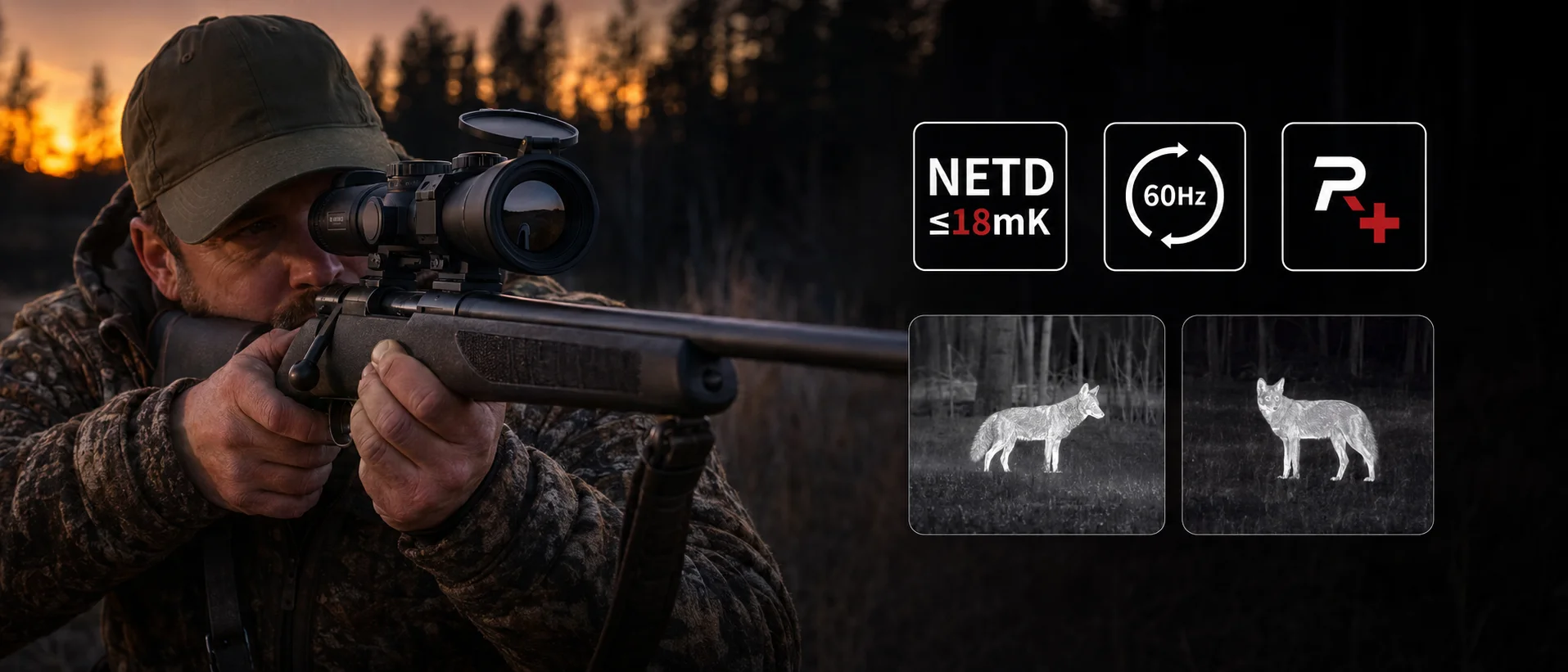
Search at base magnification so an entire gap stays visible and a trotting fox remains in frame. Magnify only after finding the animal and reading its direction.
Refocus when distance changes. Focus can sharpen a soft image; it cannot restore a body hidden by a wall, hedge, bank, or wet grass. The Nocpix thermal terms guide covers field of view, focus, LRF, and other controls.
Use the LRF only after the animal and likely return point are clear; brush, wire, or a branch may return the wrong distance.
Confirm the Fox Before Moving to the Rifle
A warm shape is a detection. Identification needs build, leg-to-body proportion, head outline, tail carriage, gait, scale, and preferably more than one view.
Dogs and cats require care around farm buildings and tracks. Wet grass may leave only the back or head visible. The Nocpix guide to thermal detection and identification explains why finding heat and identifying the animal are different stages.
If the species, distance, background, permission, or method remains uncertain, do not move to the shot.
How Does Terrain Change a Foxing Setup?
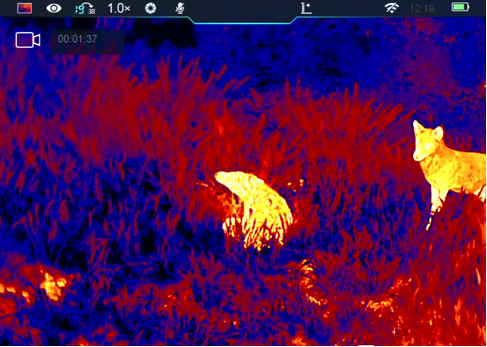
The first scan point should change with the ground. Use the table as a stand-planning guide, then adjust it to what daylight scouting actually revealed.
| Terrain | First places to scan | Main setup risk | Thermal priority |
| Hedgerows and small fields | Nearest gap, caller, ditch end, downwind opening, far margin | A fox appears briefly or reaches an unseen corner | Wide view and fast handling |
| Wet grassland | Drainage lines, raised tracks, grass breaks, drier margins | Wet vegetation fragments the outline; livestock complicates identification | Focus, contrast, and repeat views |
| Woodland edge | Close ride, track junction, cover exit, downwind lane | Short appearance windows and variable wind near cover | Wide starting view and quick refocus |
| Open fields and stubble | Caller, near ground, margins, tramlines, low rises, far boundary | Too much attention on distant ground; exposed access | Smooth coverage, detail, and LRF where lawful |
| Farm ground | Tracks, field entrances, feed areas, building edges | Dogs, cats, livestock, people, roads, and restricted arcs | Early non-target exclusion and background awareness |
In a hedgerow field, the nearest gap may deserve more attention than the far boundary. In wet grassland, the useful view may be the same partial heat signature appearing twice along a drainage line. At a woodland edge, the close ride and downwind exit come before the open field. On stubble, spend more time on margins and tramlines, but keep returning to the caller and near ground.
The same thermal and caller can therefore demand a different position and sweep only a few kilometres apart.
Which Thermal Setup Fits Fox Hunting?
Handheld Monoculars for Mobile Scanning
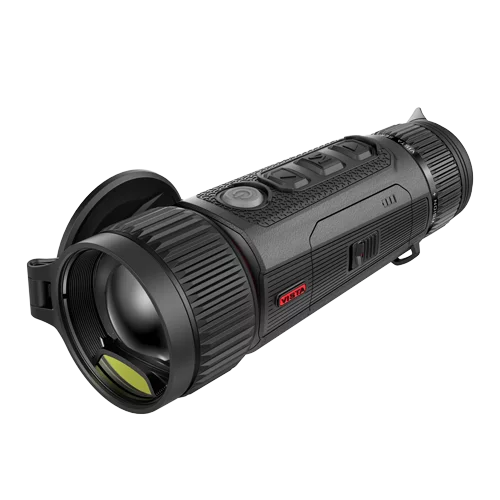
A handheld scanner is the natural starting point for hunters who walk between stands, scan one-handed, and reposition often. Compare the Nocpix thermal monocular range when portability and quick handling matter more than extended two-eye viewing.
Within that range, the LUMI series is the compact option for a hunter covering small farms, walking between fields, or making frequent short stands. Someone watching one large field for several hours may value a different format.
Thermal Binoculars for Longer Observation
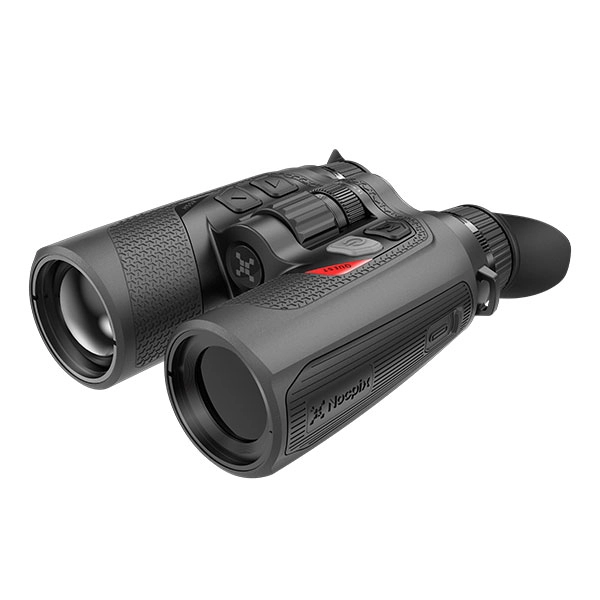
For extended scanning from a fixed position, a binocular format can reduce the one-eye fatigue associated with long observation. The QUEST series suits a longer static watch when two-eye viewing and an integrated LRF fit the ground.
That does not automatically make a binocular better for a mobile foxing route. Weight, handling, the number of stands, and how often the hunter needs a free hand remain part of the decision.
Keep the Riflescope for Aiming
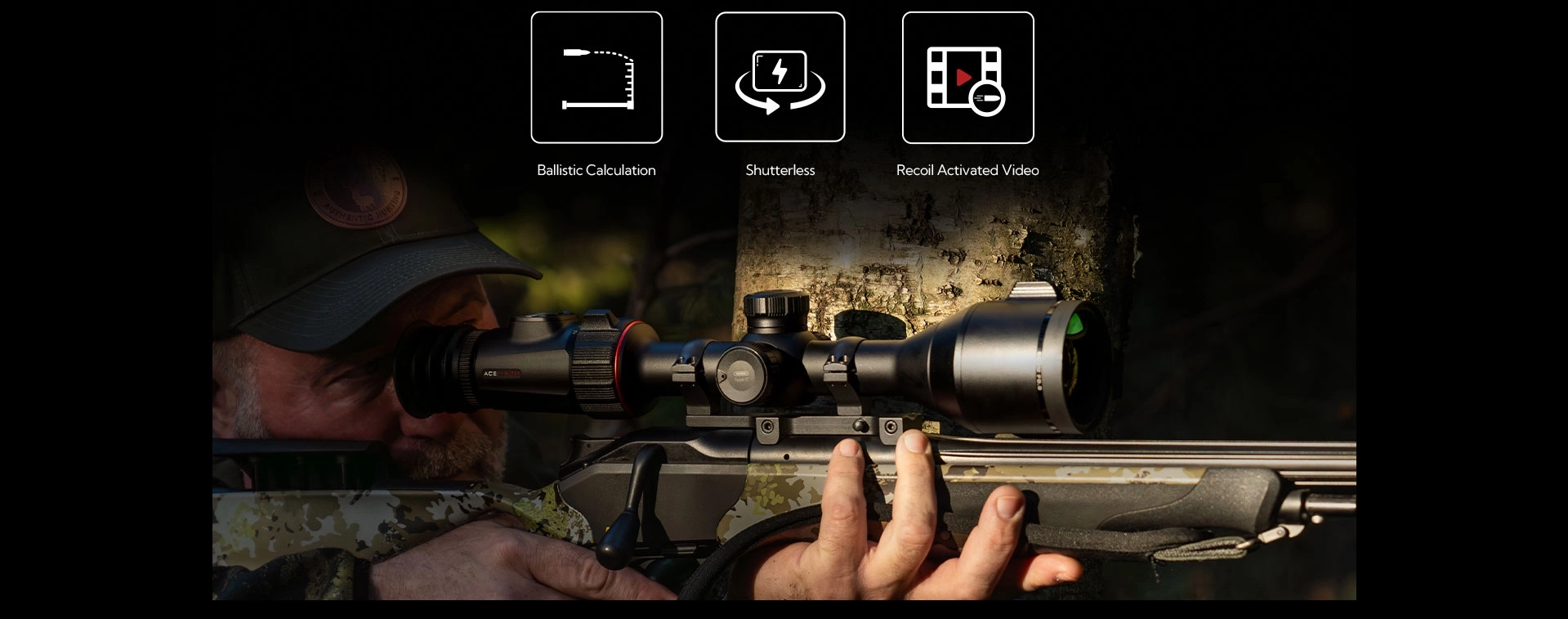
A riflescope belongs to the aiming stage, not repeated field searching. Searching through the rifle adds movement and fatigue and keeps the firearm involved when a handheld view would do the job more cleanly.
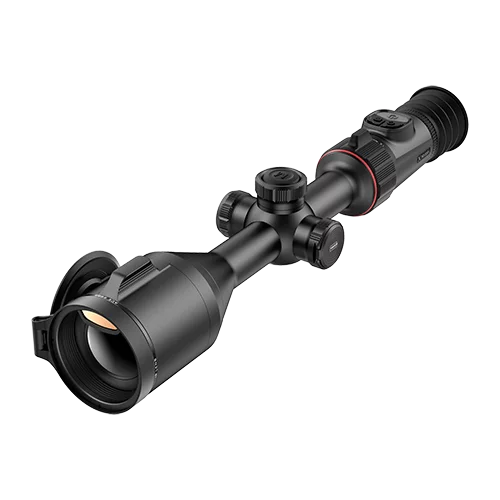
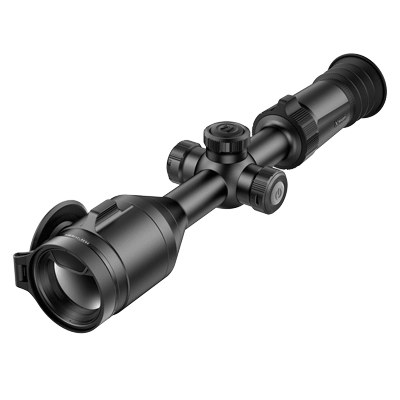
Start with the ground and the shot you expect. A close hedged field and a large open field may call for different base magnification and field of view. Then check mounting, rifle fit, LRF, and power before comparing models in the Nocpix thermal riflescope. If the BOLT series meets those requirements, include it on the shortlist. Confirm local availability and law before buying or using any scope.
Choose the optic by the job:
- frequent movement and one-handed search: monocular;
- long fixed observation: binocular;
- lawful aiming after positive identification: riflescope.
Common Night Fox Hunting Mistakes
- Walking through the watched ground: Plan the access route before choosing the most convenient seat.
- Hiding the downwind side: Move until the fox cannot reach the likely scent-checking lane entirely behind a hedge, bank, or wall.
- Starting too loudly: Scan first and begin softly for a fox already near cover.
- Calling without scanning: Use every quiet period for the same deliberate fox sweep.
- Watching only the far field: Recheck the caller, near edge, gaps, and ditch ends.
- Scanning through the riflescope: Keep search and aiming as separate jobs where practical.
- Magnifying too early: Stay wide until the fox is found and its direction is clear.
- Changing sounds before reading the fox: Check wind, route, cover, and the last visible movement first.
- Treating heat as identification: Wait for a usable combination of shape, gait, tail, scale, and context.
- Trying to call through a spoiled wind: Stop or move when scent repeatedly enters the main cover or hidden approach.
What Must You Check Before Hunting Foxes at Night?
Before leaving home, confirm that you may control foxes on that ground and that the method you intend to use is legal there that night. Landowner permission alone may not settle night shooting, electronic calls, lights, thermal aiming devices, firearm or ammunition restrictions, or rules around roads, public access, and protected land.
Rules can change between countries and regions. Check the current guidance for the exact location with the responsible hunting or firearms authority. If the rule for a device, call, or shooting time is unclear, leave it out until you have a definite answer.
Frequently Asked Questions
What Is the Best Wind for Calling a Fox?
A crosswind or quartering wind is a useful starting point when it keeps your scent away from expected cover and leaves the downwind side visible. The best wind is the one that also allows a quiet access route and a safe field of fire. No single direction fixes a stand with hidden ground.
Should You Scan Before Calling?
Yes. A fox may already be near the field edge, caller position, or a close gap. The pre-call scan also gives you a baseline, confirms that livestock and people are where expected, and lets you start quietly rather than trying to reach a fox that is already close.
Is a Thermal Monocular or Riflescope Better for Fox Hunting?
They do different jobs. A monocular is better suited to repeated handheld searching; a binocular suits longer fixed observation; a riflescope belongs to lawful aiming after the fox and background have been confirmed. Many hunters need a scanning device and an aiming device rather than forcing one optic to perform both roles.
What Makes a Night Fox Stand Work?
A good stand is rarely rescued by louder calling or more digital zoom. It works because you reached the position without carrying scent through the expected approach, the caller and downwind gaps remain visible, and every quiet pause gets another scan. If you cannot identify the animal or confirm the ground behind it, keep the rifle down and reset at the next stand.