






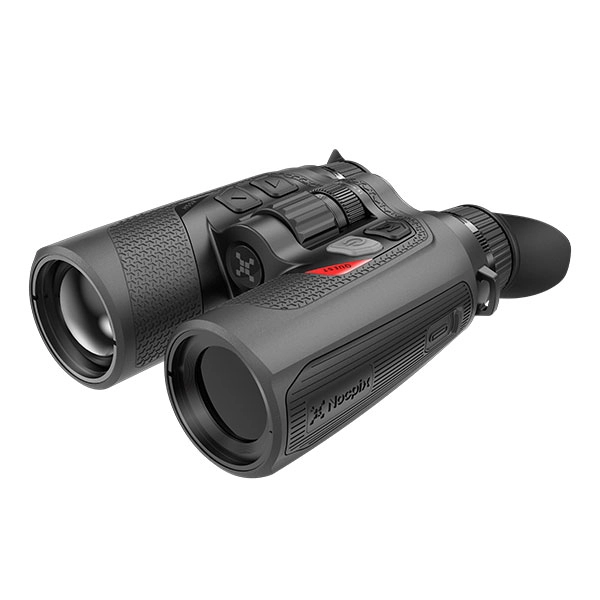
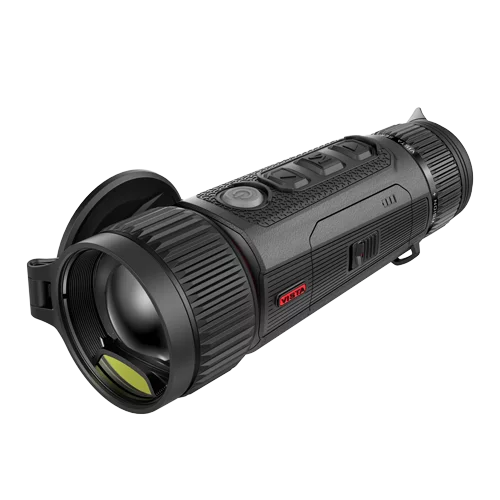
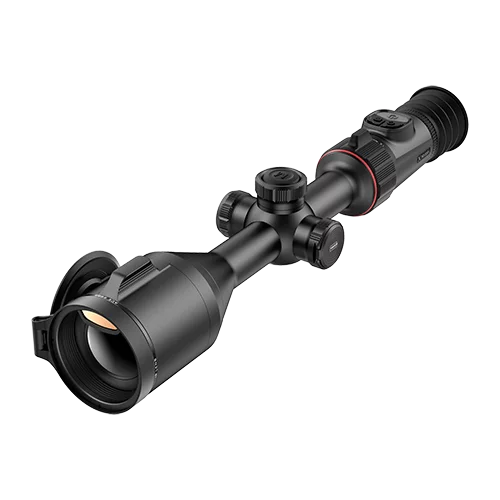
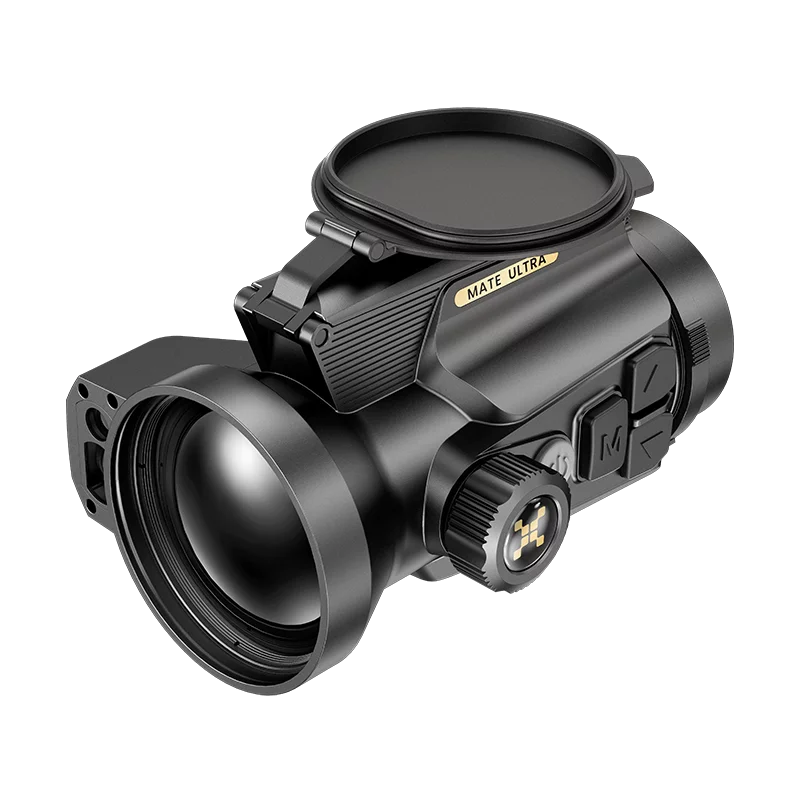


If you want the best binoculars for night hunting in 2026, thermal binoculars are the strongest overall choice. They detect body heat instead of amplifying light, so they work in complete darkness, fog, and light rain, conditions that shut down traditional night vision devices. Night vision binoculars still have a place for close-range work under moonlight or starlight, but they struggle without ambient light. Multispectral devices combine both technologies, though they cost more and add complexity most hunters don’t need.
This guide breaks down how each technology compares for real hunting situations, what specs to look for, and which Nocpix thermal binoculars fit different styles of night hunting.
Table of Contents
Quick Answer: Best Night Hunting Binoculars at a Glance
Here’s a fast summary if you already know what you need:
- Best Overall: Nocpix Quest H35R, 640×512 sensor, 35mm lens, 1,800m detection, built-in LRF, under 700g
- Best for Long-Range Detection: Nocpix Quest H50R, 640×512 sensor, 50mm lens, 2,600m detection
- Best for Maximum Image Clarity: Nocpix Quest S50R, 1280×1024 sensor, 50mm lens, widest field of view in the lineup
- Best Entry-Level Pick: Nocpix Quest L35R, 384×288 sensor, affordable, same core features as the rest of the Quest line
Each model includes dual AMOLED displays, a 60Hz refresh rate, an integrated 1,000m laser rangefinder, IP67 weather protection, and a dual-battery design. Keep reading for the full breakdown.
What Do Hunters Actually Mean by “Night Vision Binoculars”?
Most hunters searching for “night vision binoculars” aren’t looking for a specific technology. They want binoculars that help them see animals in the dark. That could mean traditional IR-assisted night vision, thermal imaging, or a newer multispectral hybrid.
The differences between these technologies are real, and they affect what you can see, how far you can detect, and how well the optic works when conditions get bad.
IR-Assisted Night Vision, How It Works
Traditional night vision binoculars amplify existing light, moonlight, starlight, or infrared illuminator light, and display a brightened green or white-phosphor image. Gen 3 and digital night vision devices do this well enough for close to mid-range use when at least some ambient light is available.
An IR illuminator adds an infrared beam that bounces off objects and returns to the sensor. This helps in very low-light environments, but the effective range is limited to how far the illuminator reaches, usually a few hundred yards at best. Beyond that range, you’re relying on whatever natural light exists.
Where Night Vision Falls Short After Dark
On a moonless night, under heavy tree cover, or in a deep draw where starlight barely reaches, standard night vision struggles. The image gets noisy, detail fades, and you lose the ability to identify animals at a distance.
Night vision also can’t see through fog, smoke, or light rain. It depends on reflected light, and when that light gets scattered, the image breaks apart. If you hunt in conditions like that, night vision alone will leave gaps in your coverage.
How Do Night Vision, Thermal, and Multispectral Binoculars Compare for Night Hunting?
Thermal binoculars outperform night vision in total darkness and bad weather. Multispectral devices offer both channels, but at a higher cost and added weight. For most night hunters, thermal is the sweet spot between performance and practicality.
Performance in Total Darkness and Bad Weather
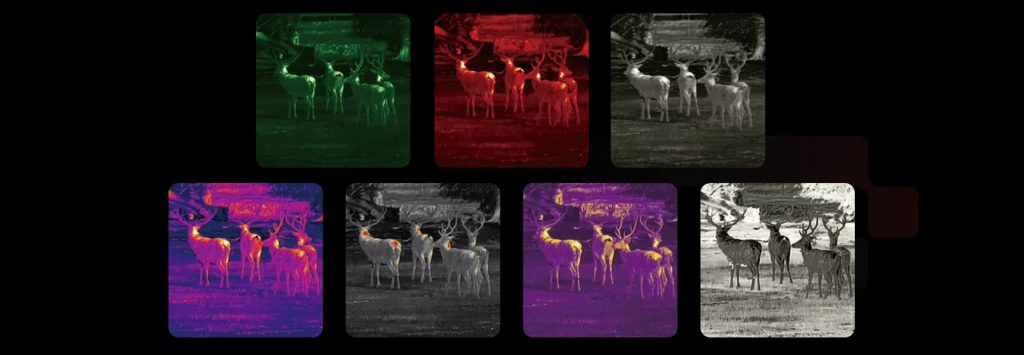
Thermal imaging binoculars detect heat rather than visible light. By sensing infrared energy from animals, people, and objects, they remain effective in complete darkness, fog, light rain, smoke, and dense vegetation.
Night vision needs light to work. Even a good Gen 3 device performs poorly on an overcast, moonless night in thick timber. Thermal doesn’t care about light at all. A warm animal stands out against a cool background regardless of ambient conditions.
Multispectral devices typically layer a thermal channel over a night vision image. This can improve target identification, but the added complexity usually comes with a heavier weight, shorter battery life, and a price tag often double or triple that of a standalone thermal binocular.
Animal Detection Speed vs. Identification Accuracy
Thermal binoculars excel at detection speed. A heat signature, even a partial one behind brush or tall grass, appears instantly on a thermal display. Warmer objects stand out brighter while cooler surroundings fall back, making movement and animal presence much easier to spot. Because they don’t depend on reflected light, thermal binoculars can still detect targets through partial obstructions where standard optics often fail.
Night vision can produce more natural-looking images, which sometimes helps with species identification in open areas. But that advantage shrinks in true darkness. A quality thermal sensor with strong NETD sensitivity and a good image processing algorithm gives you enough detail to read the shape, size, and posture of an animal at meaningful distances.
Always confirm your target before making any shot decision, regardless of which optic you use.
Why Most Serious Night Hunters Are Moving to Thermal in 2026
Three things are driving the shift. First, sensor prices have dropped over the past few years, making thermal binoculars more accessible. Second, image processing has improved;, algorithms like Nocpix’s R+ image enhancement produce cleaner, more detailed thermal images than sensors could deliver on their own just a few years ago. Third, the form factor has caught up. With a maximum weight of just 750g, and as light as 700g depending on the model, the Quest series is engineered for ultra-light portability that makes it practical for extended hunting use.
Hunters who run coyote stands at night, control hog populations on farmland, or track predators through mixed terrain want a device that works in every condition without compromise. Thermal fills that role better than any other single technology available today.
What Should You Look for When Choosing Night Hunting Binoculars?
Sensor resolution, thermal sensitivity, detection range, battery life, ergonomics, and connectivity all affect how well a thermal binocular performs during a real hunt. Here’s what each spec means in plain terms.
Thermal Sensor Resolution and NETD, The Clarity Factor
Sensor resolution determines how sharp and detailed the thermal image looks. Higher resolutions, like 640×512 or 1280×1024, deliver better target separation at longer distances. A 640×512 sensor captures about 327,000 thermal pixels. A 1280×1024 sensor captures over 1.3 million. That difference shows up when you zoom in or when two animals are standing close together at a distance.
NETD measures a sensor’s ability to detect small differences in temperature. Lower NETD values, typically below 20mK, produce clearer images in humid, rainy, or low-contrast environments. The entire Nocpix Quest lineup uses sensors rated at NETD ≤15mK, which puts it among the most sensitive sensors available in handheld thermal binoculars.
Detection Range vs. Recognition Range, Not the Same Thing
The detection range tells you how far the sensor can pick up a heat signature. Recognition range is how far you can actually tell what that signature is: a deer, a coyote, a person, or a sun-warmed rock.
For deer and hog hunting, a detection range above 1,500 meters gives plenty of headroom. Most hunters will identify targets at a few hundred yards, and that’s what matters for shot decisions. A longer detection range helps you spot movement early, giving you more time to plan your approach.
Battery Life in Cold Weather Conditions
Thermal systems consume more power than traditional optical binoculars, and cold weather drains batteries faster. A unit rated for 6 hours at room temperature may only last 4 hours at 20°F.
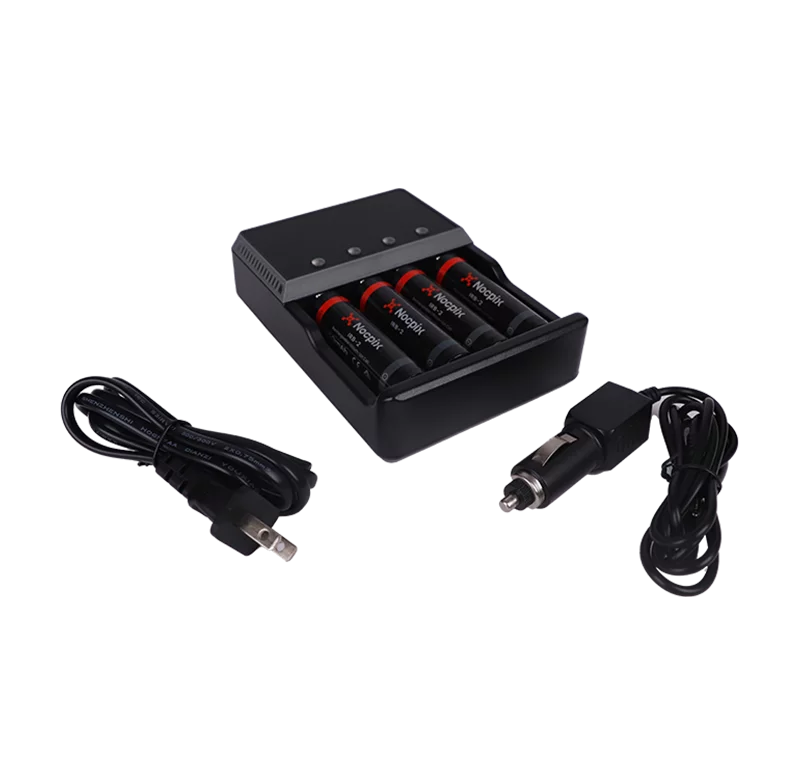
The Quest series addresses this with a dual-battery system. An internal USB-C rechargeable battery pairs with an auxiliary IRB-2 (18650-style) rechargeable battery that you can hot-swap without powering down the unit. Bring a couple of spare 18650 cells, and cold-weather battery life stops being a concern.
Ergonomics and Weight for Extended Glassing Sessions
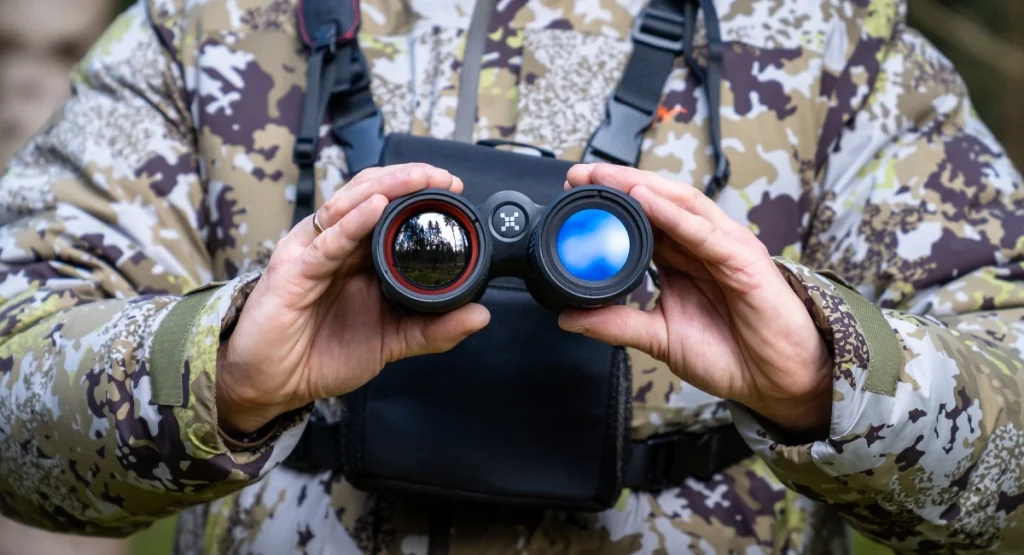
Thermal binoculars are built for extended observation. Using both eyes reduces fatigue during long viewing sessions in ways a monocular simply can’t match. If you plan to monitor an area for 30 minutes or more, binoculars feel noticeably more comfortable over time.
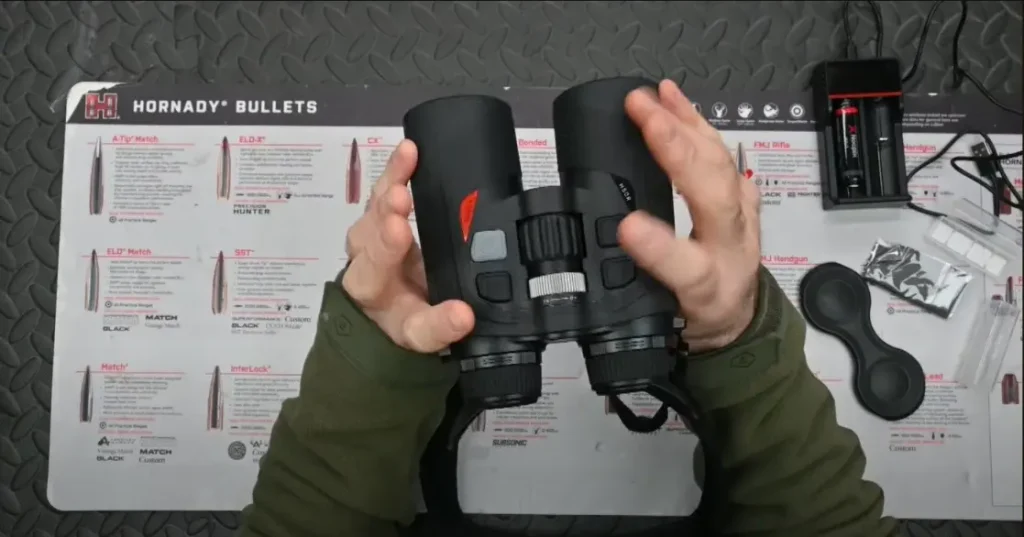
Weight matters for extended use. A thermal binocular over 900g starts to feel heavy after an hour of glassing. Quest models weigh around 700g, comparable to a pair of premium optical binoculars. Four buttons, two scroll wheels, and one-handed operation keep things manageable in the dark when gloves are on.
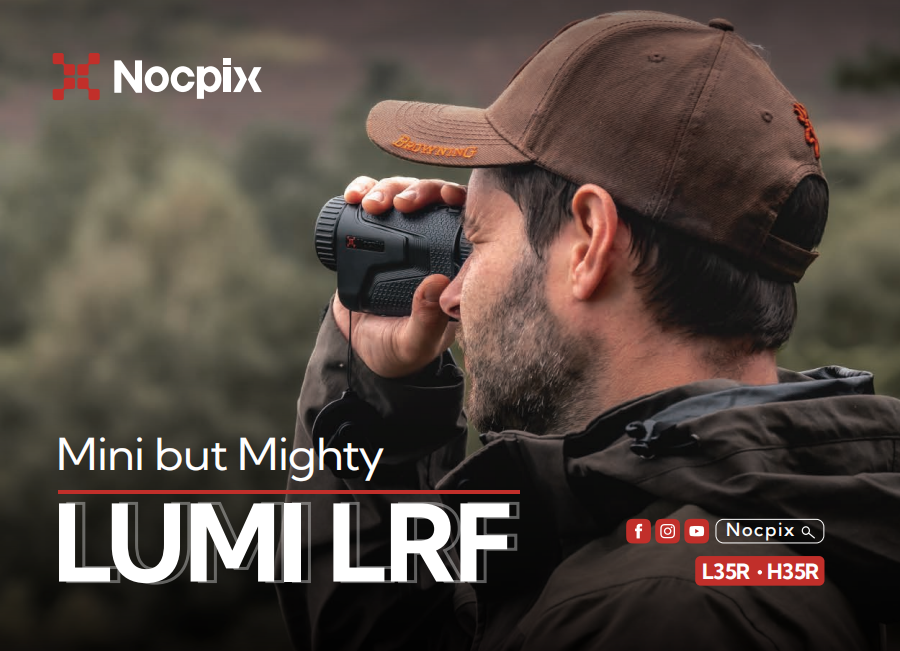
If you prefer a lighter, single-eye scanning tool for shorter sessions or quick field checks, a thermal monocular like the Nocpix LUMI series may be a better fit. For extended glassing, binoculars are the more comfortable choice.
Onboard Recording and App Connectivity
Many thermal binoculars now record video and photos directly onboard. This lets you review footage, track animal patterns over time, or share clips with hunting partners and landowners.
The Quest series supports IoT connectivity through Nocpix N-Link for real-time sharing of thermal imaging data. This is handy on group hunts or for property managers who want live field updates without everyone carrying their own unit.
Best Thermal Binoculars for Night Hunting in 2026, Nocpix Quest Series
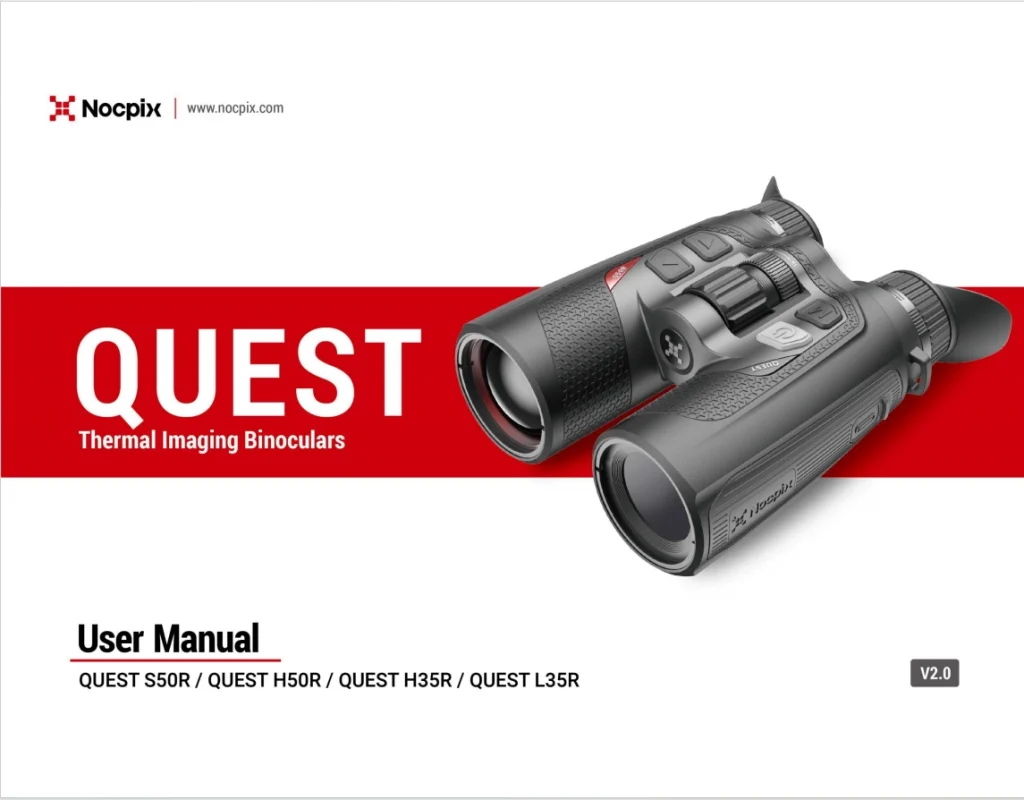
The Nocpix Quest series includes four models that cover a wide range of hunting situations. All four share the same core platform: dual AMOLED displays, a 60Hz frame rate, IP67 weather protection, a built-in 1,000m laser rangefinder, R+ image processing, electronic image stabilization, and a dual-battery system.
What changes between models is the sensor resolution and the lens size, and those two specs shape how far and how clearly you see.
Best Overall, Nocpix Quest H35R
The Quest H35R runs a 640×512 sensor with a 35mm germanium lens and 3× base magnification. The smaller lens keeps the weight under 700 grams, light enough to carry comfortably on a binocular harness during long stalks or all-night sits.
The detectionDetection range reaches 1,800 meters, which covers most hunting situations without excess. Battery life runs around 6 hours, and the dual-battery system lets you hot-swap the external 18650 cell without powering down the unit. IP67 construction handles rain and dust without issue.
If you hunt a mix of open fields, timber edges, and rolling hills, the H35R is the best balance of sensor quality, portability, and price in the Quest lineup.
Best for Long-Range Detection, Nocpix Quest H50R
The H50R steps up to a 50mm F1.10 lens and 4× base magnification while keeping the same 640×512 sensor. Its large-aperture 50mm lens gathers more light and pushes the maximum detection range to 2,600 meters. That extra reach pays off on large farmland, wide CRP fields, or open western settings where you need to spot movement from well over a mile.
With a 12-micron pixel pitch and a 60Hz refresh rate, the H50R delivers smooth, motion-blur-free imagery that holds up when animals are moving fast. For hog hunters working large fields at night or coyote hunters glassing from hilltops, the H50R earns its place as a long-range workhorse.
Best for Maximum Image Clarity, Nocpix Quest S50R
The Quest S50R sits at the top of the lineup for one reason:, image clarity. It uses Nocpix’s 1280×1024 sensor with ≤15mK NETD and a 60Hz refresh rate. That resolution level is rare in any handheld thermal binocular, and it shows in how cleanly the image resolves animals against busy backgrounds.
The 50mm F1.1 objective lens and wide 17.5°×14° field of view help you sweep large areas fast. At 100 meters, that field covers roughly 30×24 meters, enough to glass a full field edge in a single pass. The 2× base magnification keeps the view wide for scanning, and digital zoom lets you push in when you need to confirm what you’re looking at.
If you spend long nights on the glass and want the highest image detail available, the S50R is the pick. You can read more about its performance and design in Nocpix’s dedicated Quest S50R overview.
Best Entry-Level Pick, Nocpix Quest L35R
The Quest L35R is the starting point in the Quest family. It runs a 384×288 sensor with the same ≤15mK NETD and 60Hz refresh rate shared across the lineup. That thermal sensitivity matters. A 384×288 sensor with strong NETD can outperform a higher-resolution sensor with weaker sensitivity in tough field conditions.
For a hunter getting into thermal binoculars for the first time, the L35R keeps things manageable, with a four-button layout, one-handed controls, and the same dual-battery system as every other Quest model. You still get the built-in LRF, ballistic calculation support, N-Link connectivity, and IP67 durability. It’s a capable first thermal binocular that shares the same build quality and comfort design as the rest of the Quest family.
Which Night Hunting Binoculars Fit Your Hunting Situation?
The right thermal binocular depends on where you hunt, what you hunt, and how long you stay out. Matching the optic to your terrain makes a real difference in the field.
Open Fields and Farmland, Hog & Coyote Country
Wide-open ground rewards detection range and magnification. You want to spot incoming hogs or coyotes from 400+ yards and get a read on their direction before they close the distance or wind you. The Quest H50R’s 2,600m detection range and 4× base magnification give you the best reach in the lineup for this kind of work. Pair it with a quality thermal riflescope for the engagement side, and you’re covered from detection to shot.
Dense Brush, Woodlands, and Thick Canopy
In tight cover, field of view matters more than raw reach. Animals appear at close ranges, and you need to pick heat signatures out of a cluttered background full of fallen logs, warm rocks, and dense brush. The S50R’s 1280×1024 sensor provides the best target separation in these conditions. Its wide 17.5° field of view helps you sweep tree lines and trail intersections without physically moving.
Mixed or Unpredictable Conditions, Fog, Rain, Changing Light
If your hunting ground shifts from open pasture to thick timber within a few hundred yards, the H35R handles both scenarios well. It weighs less than the 50mm models, and the 640×512 sensor with ≤15mK NETD holds up cleanly in fog and light rain. All Quest models carry IP67 weather protection, so the choice between models doesn’t affect durability, just reach and resolution.
Elevated Stands and Long-Range Glassing
Hunting from a treestand or elevated blind changes your priorities. You’re stationary and scanning for longer periods. Comfort and image quality become more important than weight savings. The Quest binoculars are built around this exact use case:, dual AMOLED displays for natural eye comfort, R+ image processing for consistent sharpness, and electronic image stabilization to smooth out subtle hand movement during extended observation.
For all-night stand sessions, the S50R or H50R paired with a few spare 18650 batteries gives you the best experience. You’ll have the image quality to work through every light change from dusk to dawn.
Final Thoughts
Choosing the best binoculars for night hunting comes down to matching the optic to how you actually hunt. If you glass for long periods from a stand, a dual-eye thermal design reduces fatigue and lets you observe more naturally. If you hunt open country, a larger lens and higher detection range keep you ahead of moving animals. And if you’re buying your first thermal binocular, a solid entry-level model with strong NETD will often outperform a higher-resolution unit that cuts corners on sensor quality.
The Nocpix Quest series covers that full range, from the L35R for first-time buyers to the S50R for hunters who want the best available image clarity. All four models share the same foundation: binocular comfort, reliable build quality, integrated LRF, and field-ready design built around Nocpix’s promise of being one step ahead.
Check your local regulations, compare the models to your hunting style, and pick the optic that fits your nights in the field.
Frequently Asked Questions About Best Binoculars for Night Hunting
Are thermal binoculars legal for night hunting in all U.S. states?
No. Night hunting laws and thermal optic regulations vary by state. Some states allow thermal binoculars for hog and predator hunting at night, but restrict their use during deer seasons. Others have broader restrictions. Always check your state wildlife agency’s current regulations before heading out, and always confirm your target before making any shot decision.
Can I use night hunting binoculars on a tripod or a helmet mount?
Yes. Most thermal binoculars accept a standard ¼”-20 tripod adapter. The Quest series also includes an adjustable binocular harness for hands-free carry in the field. Tripod use works best for extended observation from a fixed position, a property boundary, a feeder area, or a field edge you’re watching for long periods.
How do thermal binoculars perform in heavy rain or snow?
Better than night vision. Heavy, sustained rain can reduce thermal detection range slightly by cooling exposed surfaces and reducing temperature contrast. But thermal binoculars still outperform night vision in wet conditions by a wide margin. IP67-rated models like the entire Quest series handle rain, dust, and brief submersion without issue.
Is it worth buying used or refurbished thermal binoculars for hunting?
Be cautious. Thermal sensors can degrade with heavy use or improper storage. Pixel defects may not show up in a quick look. If you go the used route, test the unit thoroughly in a dark environment before committing. Buying new from an authorized dealer gives you a verified sensor and manufacturer warranty backing the purchase.
What is the warranty and support like for Nocpix thermal binoculars?
Nocpix Quest binoculars come backed by a 5-year warranty, which reflects the brand’s confidence in long-term build quality. Nocpix also provides direct support through its website and authorized dealers, so help is available when you need it in the field or after the hunt.