




Many outdoor enthusiasts know the routine: one device works well in daylight, but as the light fades, it becomes less useful. Switching to another device adds weight to your gear and another step to the observation process.
The challenge is finding a solution that can handle changing light conditions without making observation more complicated.
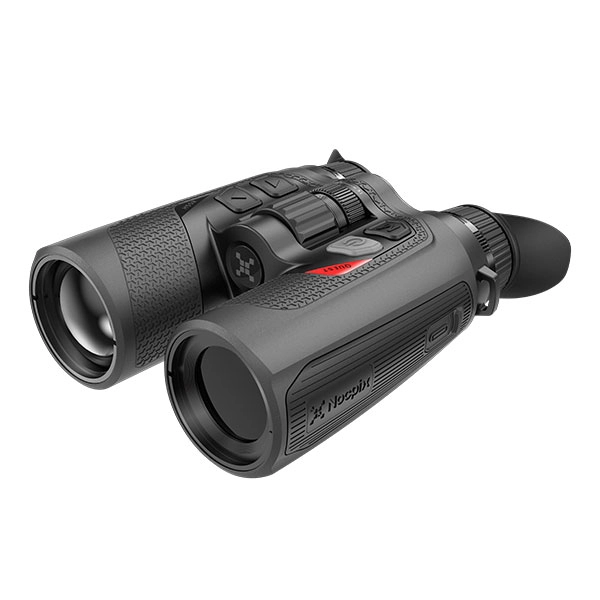
That is the idea behind the Nocpix OMNI 8K multispectral binoculars. By combining an 8K digital imaging channel with thermal imaging in one device, OMNI is designed to support observation from bright daylight through twilight and into the night.

8K Digital Imaging for Daytime Detail
In daylight, OMNI’s 8K digital sensor captures fine visual details that can help you better understand the scene. High-resolution imaging is particularly useful when observing subjects at a distance, where subtle features may be difficult to distinguish.
Details such as antler structure, feather texture, and coat patterns can provide more information than a subject’s overall outline alone. When observing wildlife in open terrain, for example, these visual details can help you examine the subject more closely.
The benefit of an 8K sensor is not simply a larger pixel count. It is the ability to capture detailed visual information that supports more informative observation, particularly when fine details matter.
Thermal Imaging for Darkness and Difficult Visibility

As daylight fades, thermal imaging offers a different way to detect a subject. Rather than relying on visible light, it detects differences in thermal radiation between objects and their surroundings.
This makes thermal imaging useful at night and in environments where visible-light observation becomes difficult. In dense vegetation, for example, an animal may be partially obscured by grass or bushes. If there is sufficient thermal contrast between the animal and its background, thermal imaging can help reveal its presence even when visual details are limited.
OMNI’s thermal channel features NETD ≤15 mK and a 50 Hz frame rate. NETD describes a thermal sensor’s ability to distinguish small temperature differences, while frame rate affects how smoothly movement is displayed. Together, these specifications support the detection and observation of thermal targets in changing outdoor conditions.
The two imaging channels serve different purposes: digital imaging captures visible details, while thermal imaging helps reveal temperature contrasts. Having both available in one device reduces the need to switch between separate optical systems as lighting conditions change.
Three Scene Modes for Changing Light Conditions
Not every observation takes place in bright daylight or complete darkness. Sunrise, sunset, overcast skies, and shaded woodland all create different imaging challenges.
OMNI’s three scene-specific algorithms are designed to optimize the image for different lighting environments.
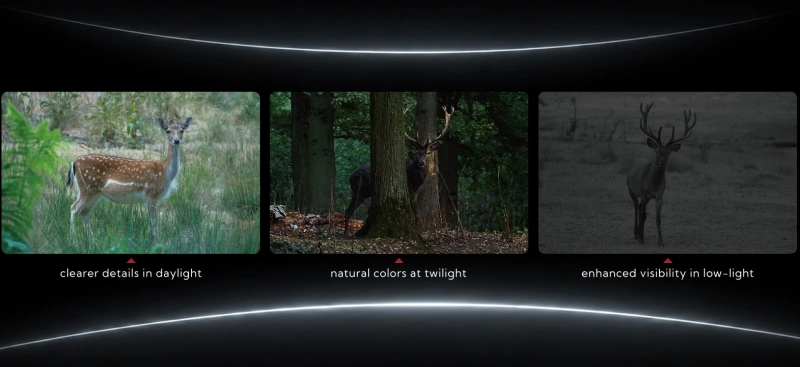
Daylight Mode: Preserve Detail in Bright Scenes
In strong sunlight, bright highlights and deep shadows can make details harder to distinguish. Daylight mode is designed to help balance these areas, supporting visibility in scenes with strong contrast.
For example, when observing an animal near snow or reflective water, managing bright areas and shadow detail can help retain more visual information across the scene.
Twilight Mode: Adapt to Transitional Light
At sunrise and sunset, or when light filters through woodland, colors and contrast can change quickly. Twilight mode is designed for these transitional conditions, helping maintain a more natural-looking image as available light shifts.
This can be useful when observing wildlife at dusk, when changing illumination may affect how coat colors and other visual features appear.
Low-Light Mode: Improve Visibility in Darker Scenes
In low-light environments, such as dense woodland or heavily overcast conditions, shadow detail becomes harder to distinguish, and image noise may become more noticeable. Low-Light mode is designed to improve shadow visibility while controlling noise.
This can help make the scene easier to interpret when observing in dim conditions, although results will still depend on the available light and the surrounding environment.
A Large Aperture for More Light
OMNI’s F1.8 aperture allows more light to reach the digital imaging system than a smaller aperture would under otherwise comparable conditions. This supports image capture in lower-light environments and complements the scene-specific algorithms.
The aperture, digital sensor, and image-processing algorithms each contribute to the imaging experience in a different way. Together with thermal imaging, they help OMNI adapt to a wider range of observation conditions without requiring users to carry separate devices for daylight and nighttime use.
One Device, Two Imaging Channels, More Flexibility
Daylight, twilight, and darkness place different demands on an observation device. High-resolution digital imaging helps preserve visible detail, while thermal imaging provides another way to detect subjects when visible light is limited. Scene-specific algorithms further adapt the digital image to changing illumination.
The advantage of the Nocpix OMNI 8K multispectral binoculars is how these capabilities work together in one system. Rather than relying on a single imaging method throughout the day, users can choose the channel and viewing mode suited to the conditions—making observation more flexible as the environment changes.