


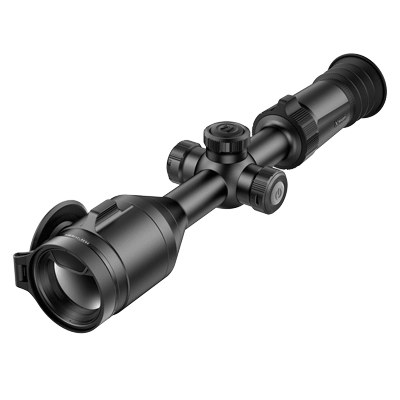


Visibility drops, reaction time shrinks, and one misunderstood call can turn into a safety issue fast when you are hunting at night. That’s why professional hunters rely on clear, shared terminology—especially when using thermal scopes and night-vision optics. These terms help you decide when to move, when to shoot, and when to stop.
This guide breaks down 100 hunting terms that matter most in night operations, with a strong focus on thermal detection, target identification, movement discipline, and ethical shot decisions. You don’t need to memorize everything. You need to understand which terms affect safety, accuracy, and communication when light is gone.
Use this article as both a learning guide and a field reference—especially if you hunt with thermal or night-vision gear.
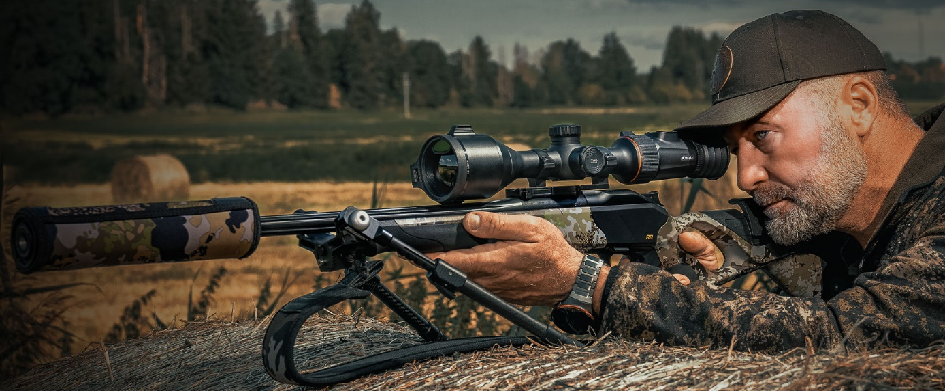
Table of Contents
How Professional Hunters Actually Use Hunting Terms
Professional hunters don’t use hunting terms to sound technical. They use them to avoid mistakes when time and visibility are limited.
At night, communication needs to be short, clear, and unambiguous. A call like “target confirmed” means something very different from “heat detected”. Mixing those up can lead to unsafe shots.
Hunting terminology helps professionals:
- Coordinate movement without unnecessary noise or light
- Confirm targets before pulling the trigger
- Adjust thermal and night-vision settings quickly
- Stop a shot when conditions aren’t right
In short, these terms keep everyone on the same page when you can’t rely on eyesight alone.
Why Hunting Terminology Matters More at Night
Hunting terms always matter, but they matter more after dark. Here’s why.
- Target misidentification is the biggest risk at night.
Terms like silhouette, eye shine, and thermal signature help hunters avoid mistaking animals for people, livestock, or non-targets.
- Movement decisions depend on shared language.
Concepts such as travel corridor, bedding area, and wind advantage guide silent, safe positioning without unnecessary exposure.
- Safety terms prevent bad shots in low visibility.
Calls like positive identification and safe direction exist to stop shots that shouldn’t happen—even if the target “looks right” through thermal.
- Night optics require precise adjustment language.
Modes such as white hot, black hot, and concepts like detection range or image noise directly affect what you see and how you interpret it.
- Animal behavior looks different at night.
Understanding terms like freeze response or flight zone helps you predict movement instead of reacting late.
At night, terminology isn’t optional—it’s part of your safety system.
Common Mistakes Beginners Make When Using Hunting Terms
Most beginner mistakes aren’t about poor shooting—they’re about miscommunication and misunderstanding terminology.
Common issues include:
- Mixing behavior terms, such as nocturnal and crepuscular, which leads to bad timing and positioning.
- Misusing thermal display modes, like switching black hot and white hot without understanding contrast loss.
- Ignoring safety language, especially positive identification and safe direction under pressure.
- Overloading technical terms, which slows decision-making instead of improving it.
- Misreading thermal signals, confusing vegetation, terrain heat, or people with animals.
The fix isn’t learning more terms—it’s learning which terms actually matter in real situations.
Spoken Terms vs Written Terms (Field Talk vs Manuals)
Hunters use terminology in two very different ways: in the field and during preparation.
Spoken Terms (Field Talk)
Spoken terms are designed for real-time decisions, especially at night:
- Short and direct
- Easy to hear and repeat
- Focused on safety and timing
- Ideal for team-based night hunts
Examples include calls like “clear,” “abort,” or “target moving left.”
Written Terms (Manuals)
Written terms support:
- Learning and training
- Gear setup and planning
- Reviewing past hunts
- Standardizing terminology for teams
Manuals explain why a term exists. Field talk is about acting on it immediately.
Pre-Hunt Planning Terms Professionals Use
Professional hunters don’t start night hunts by turning on optics. They start by reducing unknowns. These planning terms help hunters decide where to move, when to wait, and when not to take a shot at all.
Wind & Environment Terms
Wind affects scent movement, bullet behavior, and animal response, which makes it critical at night.
- Windage: Horizontal adjustment to keep shots accurate in crosswinds.
- Wind Quartering: Wind hitting the target at an angle, requiring both wind and lead consideration.
- Thermals: Shifting air currents that affect scent and bullet travel.
- Downwind / Crosswind: Directional wind terms used to plan safe approaches.
- Swirling Wind: Unstable wind that increases scent exposure risk.
- Wind Hold: Shot correction based on wind speed and direction.
- Prevailing Wind: The dominant wind pattern in a hunting area.
Equipment & Setup Terms
Night hunting leaves very little room for setup errors. Small issues that barely matter during the day can quickly show up as missed shots or poor decisions after dark.
- Zeroing/Sighting-In: Aligning your optic so the point of aim matches the point of impact at a known distance. Any change in mounting, optic position, or rifle setup means your zero should be checked again.
- Zero Shift: A change in point of impact caused by heat, recoil, mounting pressure, or environmental factors. After a few shots, even minor barrel heat can move impact enough to matter when targets are small and visibility is limited.
- Confirmation Zero: A final check to confirm your zero before hunting. Many experienced night hunters fire a single confirmation shot after transport, knowing that thermal optics don’t forgive small alignment errors.
- Cold Bore Shot: The first shot from a cold barrel, which often behaves differently than follow-up shots. In night hunting, that first shot is often the only ethical opportunity you’ll get.
- Ballistic Profile: Bullet data covering drop, velocity, and wind effects over distance. Profiles built in daytime conditions may not translate perfectly at night if temperature or altitude changes.
- DOPE (Data On Previous Engagements): Recorded data from previous shots used to guide future adjustments. At night, DOPE often replaces visual feedback, since impact confirmation is harder to see through thermal.
- Data Card: A quick-reference summary of ballistic and environmental data, used when navigating optic menus isn’t practical in low light.
- Range Card: A reference showing known distances and shooting lanes in a specific area. It helps eliminate guessing distances through thermal, especially in familiar hunting locations.
- Mechanical Offset: The height difference between the optic and the bore. At close range, failing to account for offset can cause low impacts, even when the reticle appears perfectly placed.
- Point of Impact (POI): The actual location where the bullet strikes. Because thermal optics don’t always show impact clearly, understanding POI behavior matters when deciding on a follow-up shot.
- Reticle: The aiming reference inside the optic used for holdover and shot placement. Simpler reticles often work better at night, where speed and clarity matter more than precision markings.
Legal & Ethical Planning Terms
At night, legal and ethical decisions are harder—not because rules change, but because visibility does. These terms exist to stop shots that feel possible but shouldn’t be taken.
- Legal Shooting Hours: The time window when hunting is legally permitted. Night hunters must confirm these hours carefully, as regulations often differ from daytime rules.
- Backstop: A safe area or solid surface behind the target that can stop a bullet. In darkness, identifying a reliable backstop matters as much as identifying the target itself.
- Safe Sector of Fire: A designated direction where shooting is allowed without risking others. This becomes critical when hunting in groups or near property boundaries at night.
- Positive Target Identification (PID): Confirmation that the target is legal, intended, and safe to shoot. Seeing heat alone is not PID—context, movement, and surroundings still matter.
- Ethical Shot: A shot taken only when conditions allow a quick, humane kill. Poor angles or uncertain placement are no-shot situations, even if the target is visible.
- Tag Validation: Verification that the hunter is legally authorized to take that specific animal. Night hunts don’t change tagging requirements, but they do increase the risk of mistakes.
Detection, Scanning & Observation Terms
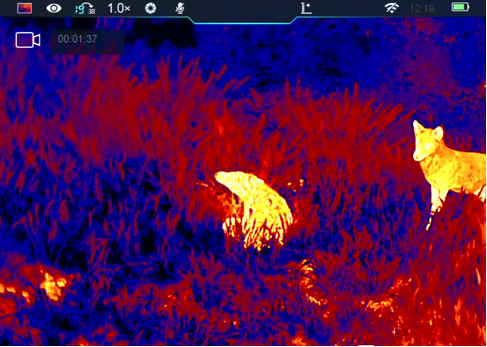
At night, detection happens fast—but understanding what you’re seeing takes discipline. These terms separate finding heat from knowing what it is and deciding what to do next.
Detection vs Recognition vs Identification (PID)
This distinction is one of the most important concepts in night hunting—and one of the most misunderstood.
- Detection: The moment a heat source is noticed through thermal or night vision. Detection only answers one question: Is something there?
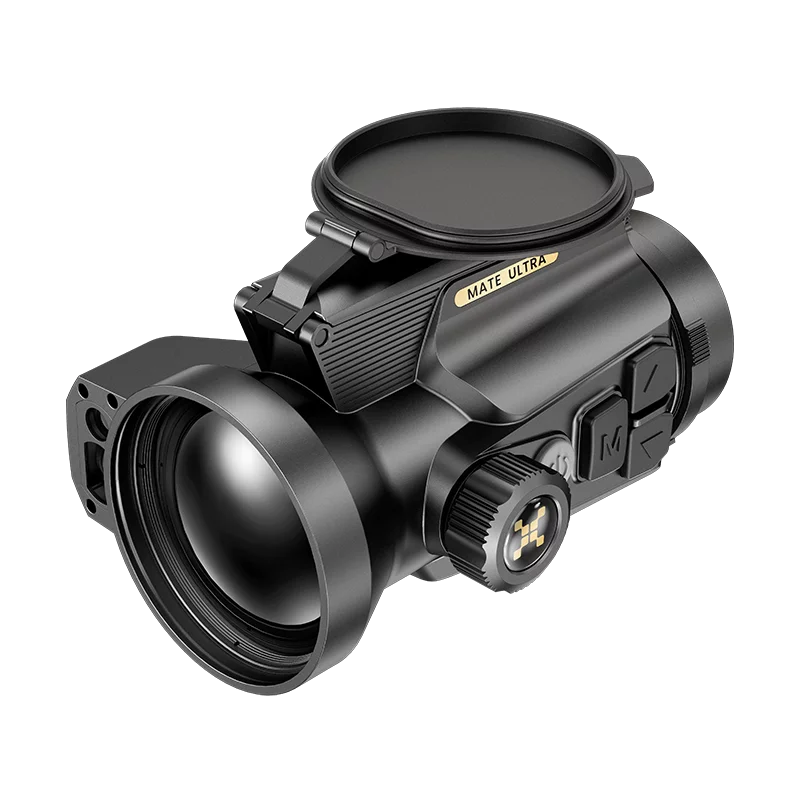
- Recognition: Determining the general type of heat source based on size, movement, and pattern. Recognition helps separate animals from people, livestock, or background heat—but it’s still not permission to shoot. When using digital night vision scope, recognition still depends heavily on movement, contrast, and context—not just image brightness.
- Identification: Confirming exactly what the target is and whether it is legal and safe to engage. Identification requires context, not just a clear heat signature.
- Positive Identification (PID):
Final confirmation that the target is legal, intended, and safe to shoot. In night hunting, PID means more than “looks right”—it means there are no unresolved doubts.
Many night-hunting incidents happen when detection is mistaken for identification. Seeing heat is not the same as knowing what you’re aiming at.
- False Positive: A heat source that appears to be a valid target but is not. Warm rocks, livestock, people, and dense vegetation can all produce convincing false positives under thermal.
Visual Scanning Terms
Scanning is not about speed—it’s about method and consistency.
- Scan: A general observation of the area using optics to locate heat or movement.
- Sweep: A controlled, steady movement of optics across an area. Sweeping too fast often causes hunters to miss stationary or partially obscured targets.
- Sector Scan: Dividing the field of view into sections and scanning each one deliberately. This reduces tunnel vision, especially when fatigue sets in.
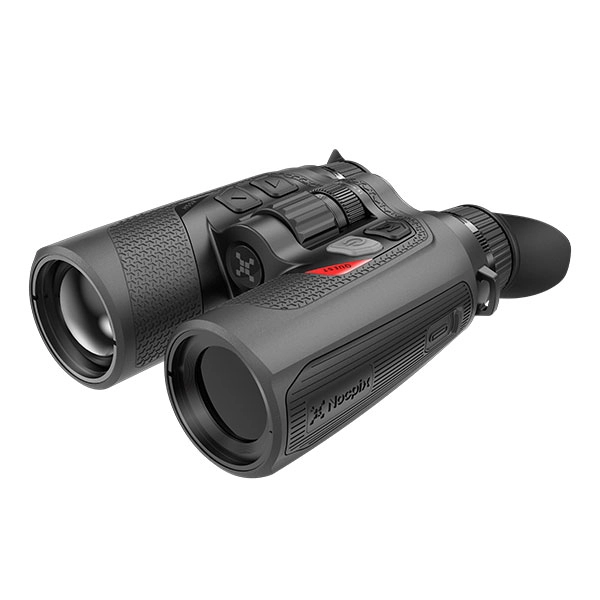
- Overwatch: Observing an area from a stable, elevated, or protected position. Overwatch allows hunters to monitor movement without constantly repositioning. Many teams rely on thermal binoculars for overwatch and wide-area scanning, reserving weapon-mounted optics strictly for confirmed engagement decisions.
- Glassing: Using optics to observe from a distance rather than moving closer. At night, glassing with thermal helps maintain concealment while gathering information.
- Target Handoff: Communicating target location, movement, and status to another hunter. Clear handoffs prevent confusion when multiple people are observing the same area through different optics.
- Visual Reference: Using fixed objects—trees, fence lines, terrain features—to track movement and maintain orientation. Without visual references, it’s easy to lose direction in thermal views.
Thermal & Night Vision Specific Terms
Thermal and night-vision optics don’t show reality—they show interpreted data. These terms help you judge whether what you’re seeing is reliable enough to act on.
- Heat Signature: The visible heat pattern of an object. Shape, movement, and consistency matter more than brightness alone.
- Thermal Contrast: The temperature difference between a target and its background. Contrast drops on warm nights or near heat-soaked surfaces (rocks, rooftops, asphalt), which makes animals blend in faster than people expect.
- Image Noise: Visual distortion caused by low contrast or environmental conditions. When noise climbs, your eyes work overtime—and that’s when hunters start “seeing what they want to see.”
- White Hot/Black Hot: Display modes that change how heat appears on screen. White Hot often makes quick scanning easier, while Black Hot can help maintain detail on bright targets. The right choice depends on background temperature and what you’re trying to confirm.
- Color Palette: Alternative display color schemes that can improve target separation in certain conditions. Palettes don’t change reality—they change how clearly you can separate a target from clutter.
- Refresh Rate (Hz): How often the image updates per second. Low refresh rates make movement look choppy, which increases misreads on running animals and makes steady tracking harder.
- Field of View (FOV): How much area you can see at once. Wider FOV helps scanning and tracking. Narrower FOV helps aiming detail—at the cost of situational awareness.
- Thermal Bloom: When a hot object “spills” and washes out nearby detail. This can make edges look bigger than they are, which is one reason small animals sometimes look “oddly thick” in thermal.
- Detection Range vs Identification Range vs Usable Range
- Detection Range: You can tell something warm is present. Manufacturers often advertise detection range, not usable range.
- Identification Range: You can confidently confirm what it is—and what it isn’t.
- Usable Range: The distance at which you can hunt responsibly with your setup and conditions.
Confusing detection with identification is one of the most common night-hunting mistakes.
- Image Lag/Frame Drop: A delay or stutter between real movement and what you see on-screen. If the picture can’t keep up with motion, slow down your interpretation—especially before calling PID.
- Sensor Saturation: When extreme heat sources overwhelm the sensor and reduce usable detail. This is more common around engines, generators, buildings, and sun-heated surfaces early in the night.
Tracking, Stalking & Movement Terms
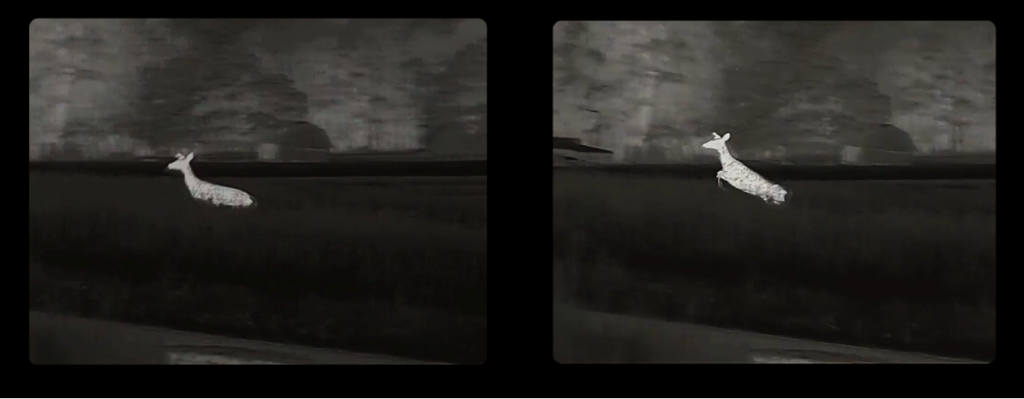
At night, movement decisions matter as much as detection. Poor tracking or careless movement doesn’t just spook animals—it erases information. These terms describe how experienced hunters control pace, noise, and exposure when visibility is limited.
Tracking Terms
Tracking at night is less about following footprints and more about interpreting incomplete signs.
- Sign: Any indication that an animal is or was present, such as tracks, disturbed soil, or broken vegetation. At night, signs are often partial and easy to over-interpret.
- Fresh Track: A recent footprint or disturbance that still holds shape and contrast. Fresh tracks matter most when thermal contact is lost and movement needs to be predicted.
- Cold Track: An older track with reduced definition. Following cold tracks at night often leads to wasted movement and loss of situational awareness.
- Track Aging: Estimating how old a track is based on clarity and environmental conditions. Darkness makes aging harder, which is why experienced hunters rely on multiple signs, not tracks alone.
- Trail Crossing: A location where an animal intersects a known path or route. Trail crossings are often monitored rather than rushed, especially in night setups.
- Drag Mark: Ground disturbance caused by body contact or dragging. Drag marks are easier to misread at night, particularly on uneven or heat-retaining surfaces.
- Disturbed Ground: Subtle changes in soil or vegetation indicating movement direction. In low light, disturbed ground is more reliable when confirmed alongside wind and terrain cues.
Stalking & movement terms
Stalking at night prioritizes control over speed.
- Still Hunting: Slow, deliberate movement with frequent pauses. Still hunting works best when combined with repeated scanning rather than continuous motion.
- Slow Roll: A steady, continuous advance that minimizes sudden movement. Slow roll is often used when thermal contact is maintained but distance must close gradually.
- Belly Crawl: Low-profile movement used to stay below terrain or cover lines. At night, this is less about visual concealment and more about reducing thermal exposure.
- Shadow Movement: Using natural shadows created by moonlight or terrain to mask motion. Shadows help visually, but they don’t always reduce thermal visibility.
- Break Cover: Leaving concealment to move into open ground. Breaking cover at night is a commitment—once done, reversing without exposure is difficult.
- Step-and-Pause: A movement pattern where each step is followed by a pause. This rhythm helps detect motion in the environment that continuous walking would miss.
Night-specific movement concepts
Night movement requires discipline beyond basic stalking skills.
- Light Discipline: Limiting use of visible light sources. Even brief light use can reset an animal’s alert state and compromise concealment.
- Noise Discipline: Controlling equipment, footing, and movement sounds. Noise travels farther at night, especially in still air.
- Silhouette Discipline: Avoiding positions where your outline is visible against the horizon or background. Silhouettes remain identifiable even when detail is lost.
- Thermal Masking: Using terrain features—trees, rocks, elevation changes—to block or distort thermal exposure. Thermal masking reduces detection risk but is never absolute.
- Backlighting: When light sources behind a hunter expose movement or position. Backlighting is easy to miss at night and often reveals presence before sound does.
Shot Execution & Engagement Terms
In night hunting, the hardest part isn’t pulling the trigger—it’s deciding whether you should. These terms describe how experienced hunters control engagement timing, avoid forced shots, and stop actions that shouldn’t continue.
Shot Setup Terms
These terms focus on pre-shot judgment, not marksmanship.
- Holdover: Aiming above the target to account for bullet drop at distance. At night, uncertain range estimation makes excessive holdover a common source of missed or unsafe shots.
- Shot Angle: The relative angle between shooter and target. Poor angles reduce vital-zone access and increase the chance of wounding rather than a clean kill.
- Lead (Moving Targets): Aiming ahead of a moving animal to account for motion. Night conditions compress reaction time, which is why many professionals avoid taking moving shots altogether.
- Range Estimation: Judging the distance to the target. Thermal optics can distort depth perception, making range estimation one of the most error-prone steps at night.
- Known Distance: A confirmed distance, usually from prior ranging or mapped terrain. Known distances reduce hesitation and help avoid rushed adjustments.
- Unknown Distance: An estimated distance without confirmation. Most ethical no-shot decisions at night begin here.
- Shot Window: A brief opportunity where conditions align for a responsible shot. When the window closes, forcing the shot rarely ends well.
- Ballistic Correction: Adjustments made for environmental and ballistic factors. Corrections are only reliable when the inputs—distance, angle, wind—are trustworthy.
- Recoil Management: Controlling the firearm before and after the shot. In night hunting, poor recoil control often delays impact confirmation and follow-up decisions.
Ethical Shot Placement Terms
These terms exist to define when a shot is acceptable—and when it isn’t.
- Vital Zone: Areas that allow for a quick, humane kill, typically the heart–lung region. Limited visibility makes clear vital-zone access non-negotiable.
- High-Percentage Shot: A shot with a high likelihood of immediate effectiveness. If the percentage feels low, experienced hunters walk away.
- Quartering-Away Shot: A favorable angled presentation that exposes vital organs. At night, confirming this angle is more important than distance.
- Broadside Shot: A perpendicular angle offering clear access to the vital zone. This is often considered the baseline for ethical night shots.
- No-Shot Condition: Any situation where uncertainty outweighs opportunity—poor angle, unclear PID, unstable movement, or unknown distance. Recognizing no-shot conditions is a professional skill, not hesitation.
Professional-Only Engagement Language
Clear language prevents rushed decisions when pressure is high.
- Target Confirmed: The target has been detected, recognized, and positively identified. Confirmation is a process, not a glance.
- Clear to Fire: All conditions—legal, ethical, and situational—are met. This call should feel calm, not rushed.
- Abort the Shot: An intentional decision to stop the engagement. Abort calls are signs of control, not failure.
- Send It: A final verbal confirmation to take the shot once all checks are satisfied. Professionals use this sparingly, not emotionally.
- Weapons Cold: A status indicating no active engagement. Declaring weapons cold helps prevent accidental discharges during movement or repositioning.
After-the-Shot & Recovery Terms
In night hunting, pulling the trigger doesn’t end the decision-making process. In many cases, what happens after the shot matters more than the shot itself. These terms guide how experienced hunters confirm impact, avoid unnecessary risk, and recover animals responsibly in low-light conditions.
Immediate Post-Shot Terms
These terms focus on confirming outcomes before moving forward.
- Follow-Up Shot: A second shot taken to ensure a humane outcome when the first shot does not immediately incapacitate the animal. At night, rushing a follow-up without confirmation often creates more uncertainty, not less.
- Impact Confirmation: Verifying whether the shot connected as intended. Thermal optics may not clearly show impact, which is why confirmation relies on movement, posture changes, and sound—not just the reticle view.
- Hit Reaction: The animal’s immediate response after impact. Sudden drops, directional movement, or lack of reaction all carry different meanings that should be interpreted before advancing.
- Audible Impact: Sound cues—such as a solid hit or ground contact—used when visual confirmation is limited. Audible information becomes more valuable as visibility decreases.
- Miss Call: A deliberate acknowledgment that the shot missed. Calling a miss early prevents false assumptions and unnecessary tracking risks.
- Shot Assessment: A rapid evaluation combining visual, audible, and behavioral cues. Good assessment often delays movement rather than accelerating it.
Recovery & Tracking Terms
Once movement begins, priorities shift from engagement to information preservation.
- Blood Trail: Visible signs left by a wounded animal. Blood trails are harder to interpret at night and should be followed slowly to avoid destroying evidence.
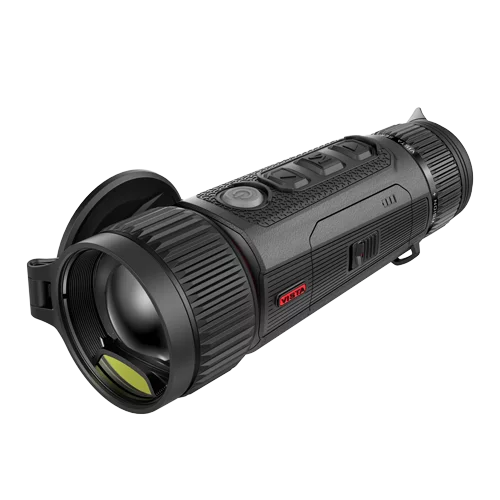
- Thermal Confirmation: Using thermal optics to verify the location or condition of a downed animal. Confirmation reduces guesswork before close approach. During recovery, thermal monoculars are often used for confirmation scans, allowing safer movement without committing to a firing position.
- Downed Animal: An animal believed to be incapacitated. Even when an animal appears down, approach should remain cautious until status is confirmed.
- Expired: Confirmation that the animal has fully expired. This determination should be made deliberately, not assumed based on stillness alone.
Night Recovery Considerations
Night recovery introduces challenges that don’t exist during daylight.
- Heat Retention: The length of time an animal’s body retains warmth after movement or death. Retained heat can aid location but may also mask subtle motion.
- Thermal Fade: The gradual loss of heat signature over time. As contrast fades, identification becomes harder, especially in warm environments.
- Contrast Loss: A reduction in visible separation between the animal and background terrain. Contrast loss increases the risk of overlooking a downed animal or misreading terrain features.
- Secondary Scan: A state where no immediate hazards remain. Declaring a scene secure helps reset focus from engagement to recovery.
Night Hunting–Only Terms Many Hunters Don’t Explain
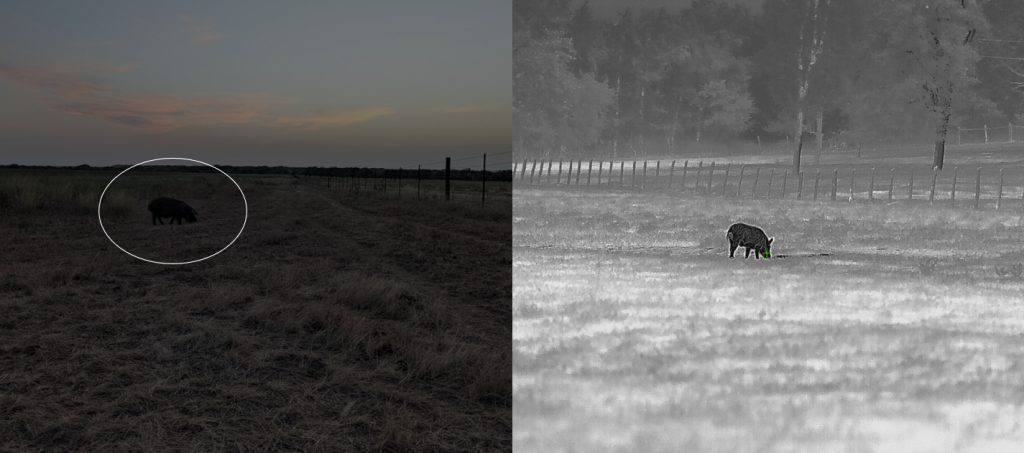
Some night-hunting terms don’t show up in manuals or beginner guides. They come from long hours behind thermal optics—and from learning where judgment starts to slip when conditions aren’t ideal.
This section focuses on why experienced hunters slow down, even when the image looks clear.
Thermal performance terminology
These terms describe what your thermal device can technically do—and, just as importantly, what it struggles to do under real conditions.
- NETD (Noise Equivalent Temperature Difference): A measure of how well a thermal sensor distinguishes small temperature differences. Lower NETD helps when animals are close to background temperature, such as warm nights, light brush, or partial cover.
- Digital Zoom vs Optical Zoom: Digital zoom enlarges pixels and removes context. Optical zoom preserves detail. Heavy digital zoom often creates confidence without clarity, especially when confirming PID at distance.
Image & device behavior terms
These terms explain why the image on your screen may not match what’s happening in real time.
- Image Lag: A delay between real movement and what appears on screen. Lag becomes noticeable when tracking moving animals and can lead to overcorrecting aim.
- Frame Drop: Skipped or uneven image updates caused by processing limits. Frame drops make movement appear erratic and increase misreads during scanning.
- Sensor Saturation: When extreme heat overwhelms the sensor and reduces usable detail. Vehicles, buildings, generators, and sun-heated surfaces commonly cause saturation early in the night.
- Thermal Washout: A loss of contrast when ambient temperatures rise and everything begins to look similar. Washout makes animals blend into terrain, even when they are still clearly present.
Real-world usage terms from professionals
These are not technical specifications—they describe how human perception changes during extended night hunting.
- Scan Fatigue: Mental exhaustion caused by prolonged scanning through thermal optics. As fatigue increases, recognition accuracy drops, even though confidence often rises.
- False Confidence: A condition where repeated successful detections lead hunters to trust the image too quickly. It often appears right before misidentification errors.
- Tunnel Viewing: Over-focusing on a narrow field of view or zoomed-in image, causing loss of situational awareness. Tunnel viewing is a common reason hunters miss secondary animals or background hazards.
Night Hunting & Species-Specific Hunting Terms
Different species and hunting styles amplify different risks.
- Hog / Boar Hunting: Often involves groups, overlapping heat signatures, and fast movement. Proper PID and backstop awareness are critical to avoid unsafe shots.
- Coyote Hunting: Characterized by quick movement and brief shot windows. Recognition and lead judgment matter more than raw detection distance.
- Bird Shooting: The hunting of various types of flighted birds at night using thermal optics.
- Predator Hunting: Targets animals like foxes and bobcats that use cover and pause frequently. Misidentification with terrain features is more common than hunters expect.
- Varmint Hunting: Focuses on smaller animals with lower heat output. Thermal contrast, NETD, and magnification choices play a larger role here than in big-game night hunting.
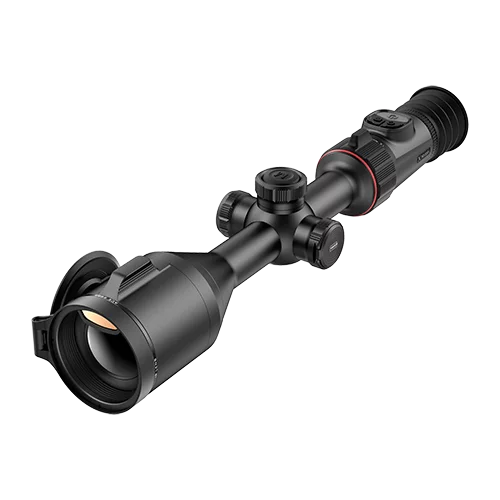
- Long-Range Night Hunting: As distance increases, identification confidence drops faster than detection ability—one reason experienced hunters prioritize restraint over reach when choosing thermal rifle scopes.
Why Understanding These Terms Makes You a Safer, More Effective Hunter
Understanding hunting terms isn’t about memorization. In night hunting, these terms shape how decisions are made when visibility is limited and assumptions fail quickly.
Safety Implications
At night, safety failures usually begin with misinterpretation, not equipment. Terms like positive identification, safe sector of fire, usable range, and no-shot condition create deliberate pause points that prevent rushed decisions when information is incomplete. Shared terminology helps expose uncertainty before it turns into action.
Ethical Hunting Implications
Ethical night hunting depends on restraint, not opportunity. Concepts such as vital zone, high-percentage shot, follow-up shot, and abort the shot remind hunters that visibility alone doesn’t justify engagement.
In practice, ethics at night means choosing certainty over temptation—and understanding that visibility does not equal permission.
Better Communication When Hunting in Teams
Night hunting often involves multiple people observing through different optics, from different positions, with different perspectives. Without shared terminology, coordination breaks down quickly.
Clear engagement language—such as target confirmed, hold position, clear to fire, weapons cold, and scene secure—allows teams to synchronize actions without rushing decisions. These terms reduce ambiguity, prevent silent assumptions, and keep communication calm under pressure.
Conclusion
Night hunting isn’t defined by how far you can see—it’s defined by how well you decide when information is incomplete.
The terms in this guide don’t exist to sound technical. They exist to slow decisions, expose uncertainty, and prevent small mistakes from turning into serious ones. From detection and movement to shot execution and recovery, experienced hunters rely on shared language to know when to proceed—and when to stop. Understanding these terms doesn’t make night hunting easier. It makes it more deliberate, more ethical, and far safer.
At Nocpix, we design and evaluate our gear around the same principles described in this guide. Clear identification, usable range over advertised range, and decision clarity matter more than raw specifications. If you’re exploring night hunting with thermal or night-vision optics, we encourage you to start with understanding how judgment works after dark—before worrying about features.