






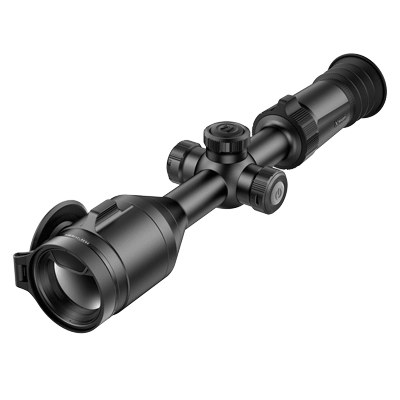
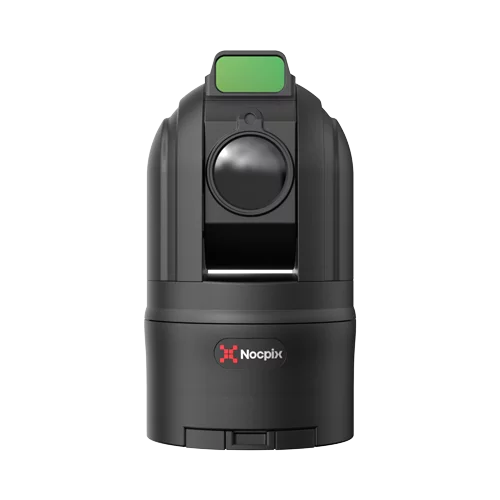
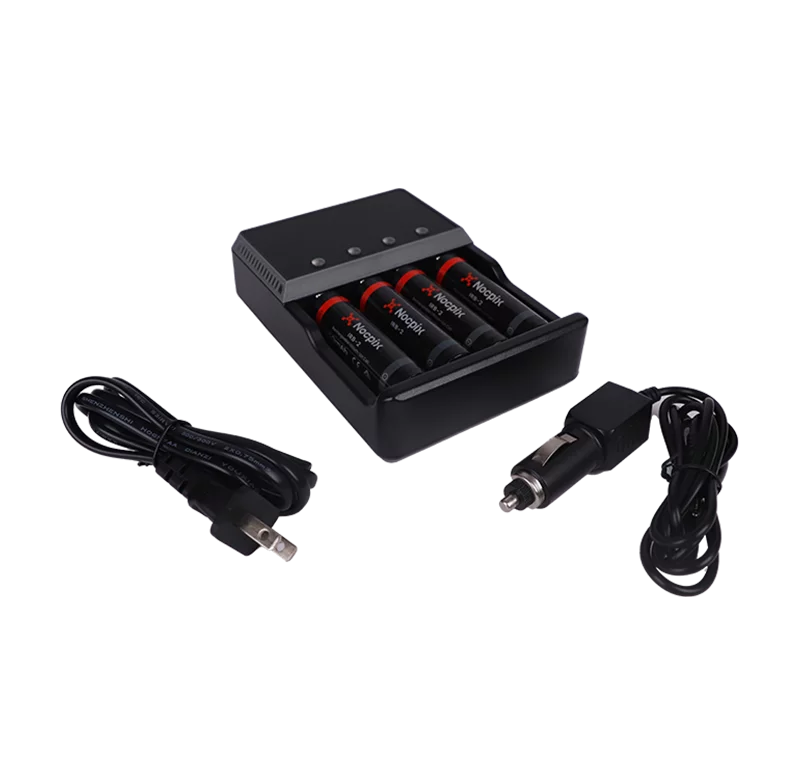


Le choix d'un montage pour lunette thermique est avant tout une question de compatibilité. Le montage doit s'adapter à la carabine, être compatible avec l'optique, positionner l'écran de manière à ce que votre œil puisse le lire, et rester stable après le recul, le transport et les manipulations sur le terrain.
Cela paraît simple jusqu'à ce qu'on compare les rails, les anneaux, les leviers de démontage rapide, les montages déportés, les sabots propriétaires et les adaptateurs à clip. Un montage d'apparence standard peut s'avérer inadapté si l'espacement des rails, la hauteur, le dégagement oculaire, l'accès à la batterie ou l'interface optique ne correspondent pas.
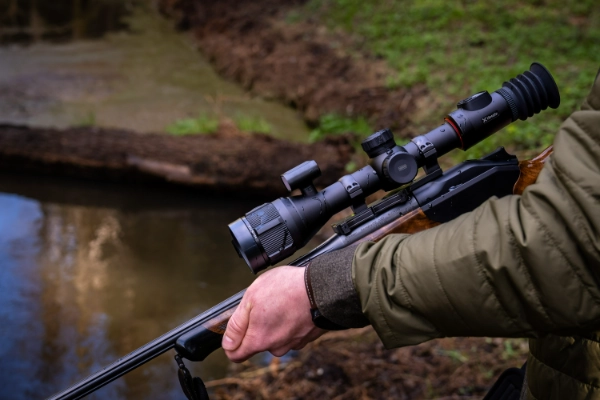
Utilisez ce guide comme liste de vérification avant achat. Avant d'acheter un système de montage pour lunette thermique, vérifiez l'interface côté carabine, l'interface côté lunette, la position de montage, la hauteur et la procédure de réglage après installation.
Que faut-il vérifier avant d'acheter des supports pour lunette thermique ?
Avant d'acheter des supports pour lunette thermique, vérifiez cinq points essentiels : le rail ou l'embase de votre carabine, l'interface de montage de l'optique, le type de support, la position de visée et la méthode de vérification du montage après installation. Si l'un de ces éléments ne correspond pas, le support peut sembler convenir sur le papier, mais s'avérer inutilisable en pratique.
Le meilleur moyen d'éviter un mauvais achat est de rassembler les informations suivantes avant d'ajouter quoi que ce soit à votre panier.
| Vérifier | Que confirmer | Pourquoi cela affecte la configuration |
|---|---|---|
| rail ou embase pour fusil | Rail Picatinny, Weaver, à queue d'aronde, embase percée/taraudée ou rail spécifique au modèle | Le support doit se fixer correctement sur le fusil. |
| interface de montage de lunette | Socle intégré, corps tubulaire, sabot de montage ou adaptateur fourni | Tous les viseurs thermiques n'utilisent pas d'anneaux. |
| Style de montage | Fixe, QD, cantilever, monobloc, anneaux ou matériel spécifique au modèle | Le style influe sur l'élimination, l'équilibre et la répétabilité. |
| Hauteur de montage | Hauteur au-dessus du rail et position de la joue | L'écran doit être aligné avec votre œil sans que vous ayez à lever ou baisser la tête. |
| Dégagement oculaire | Distance entre l'œil et l'oculaire | La sécurité liée au recul et le confort de vision en dépendent tous deux. |
| Autorisation | Objectif, oculaire, porte du compartiment à piles, ports, poignée de verrouillage et commandes | Un support peut bloquer des pièces dont vous avez besoin sur le terrain. |
| Support de recul | Capacité de montage, surface de serrage, qualité de la visserie et serrage correct | Un support mobile modifie le point d'impact. |
| Plan zéro | Premier zéro, groupes de confirmation et calendrier de revérification | La configuration n'est pas terminée tant que le zéro n'est pas confirmé. |
Si vous comparez les accessoires Nocpix, Supports et matériel Cette page est un point de départ utile, mais la même règle s'applique toujours : il faut vérifier que l'optique, le fusil, la région et l'utilisation prévus correspondent exactement avant d'acheter.
Un dernier conseil : ne partez pas du principe que le montage fourni, s’il y en a un, est la seule configuration possible. Il peut s’avérer efficace, mais il est indispensable de vérifier l’ensemble du système, notamment la crosse, l’espace sur le rail, la position de tir et le dégagement oculaire.
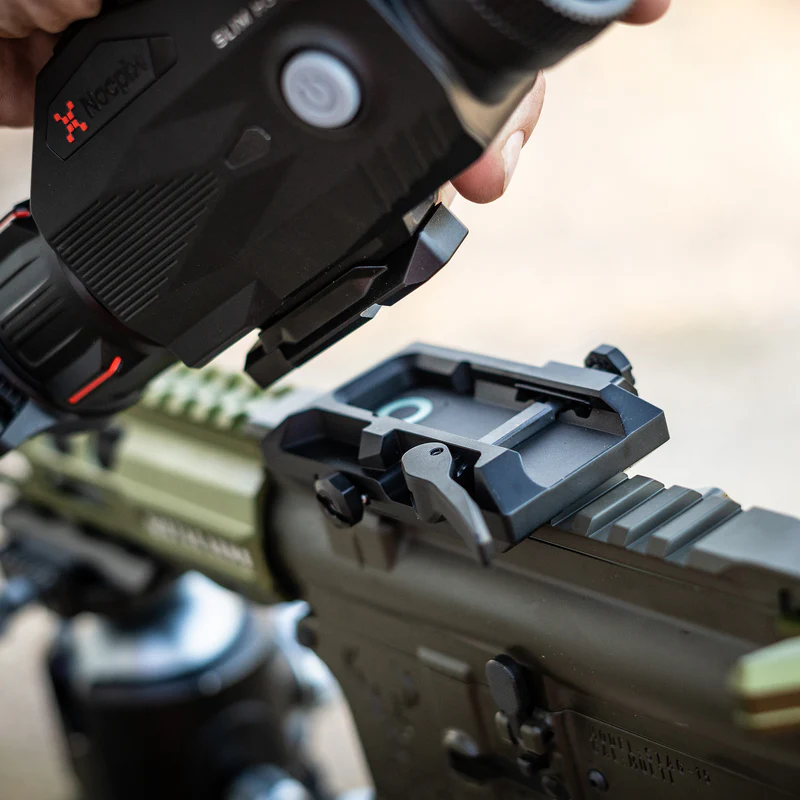
En quoi les systèmes de montage des lunettes thermiques diffèrent-ils ?
Les systèmes de montage pour lunettes thermiques diffèrent car les optiques thermiques ne sont pas conçues autour d'un corps universel. Certaines se fixent comme une lunette de visée classique. D'autres utilisent un montage Picatinny monobloc. D'autres encore utilisent un sabot ou un rail spécifique. Les accessoires thermiques à clipser fonctionnent différemment car ils se placent devant l'optique de jour au lieu de la remplacer.
Supports de rails Picatinny et Weaver
Le système Picatinny est le plus répandu pour le montage d'optiques thermiques sur les fusils modernes. Son espacement standardisé des rainures permet un serrage précis et constant des supports. De nombreux fusils de type AR et carabines à verrou modernes utilisent des rails Picatinny.
Les rails Weaver se ressemblent, mais leurs fentes sont souvent plus étroites et moins standardisées. Certains montages sont compatibles avec les systèmes Picatinny et Weaver, d'autres non. L'hypothèse risquée est que “ montage sur rail ” signifie une compatibilité automatique entre les deux systèmes.
Avant de commander un support de rail pour lunette thermique, vérifiez le type de rail indiqué par le fabricant. Si le support est conçu uniquement pour le Picatinny, ne forcez pas son installation sur une base Weaver, même si cela semble compatible.
Supports monoblocs, cantilever et QD
Les montages monoblocs relient l'optique au rail par un seul corps. Robustes et faciles à aligner grâce à leur conception monobloc, ils constituent, pour de nombreuses carabines thermiques dédiées, la solution la plus élégante.
Les montages en porte-à-faux permettent de positionner l'optique vers l'avant. Ils sont courants sur les fusils de type AR, où l'espace sur le rail et la position de l'œil peuvent être restreints. Un montage en porte-à-faux permet de mieux éloigner l'oculaire, mais modifie également la répartition du poids.
Les montages QD utilisent des leviers ou des systèmes de fixation rapide, permettant un démontage plus rapide de l'optique. Ils sont pratiques lorsqu'on change d'optique d'arme, lorsque l'arme doit être rangée dans un étui, ou lorsque le tireur souhaite retirer l'optique après la chasse. Un montage QD nécessite tout de même une vérification. Un démontage rapide ne garantit pas un retour parfait au zéro à chaque fois.
Anneaux de lunette thermique et optiques montées sur tube
Les anneaux de montage pour lunettes thermiques ne sont nécessaires que si l'optique est conçue avec un corps tubulaire compatible avec ce type de montage. De nombreuses lunettes de jour classiques utilisent des anneaux de 30 ou 34 mm, mais les lunettes thermiques présentent une plus grande variété de dimensions.
Certaines optiques thermiques ont un profil tubulaire. D'autres sont de forme rectangulaire, possèdent une base intégrée ou un rail spécifique. Si la fiche produit n'indique pas le diamètre du tube, ne faites pas de suppositions : demandez le type de montage approprié.
Les anneaux doivent également être à la bonne hauteur. Des anneaux trop bas peuvent être esthétiques, mais ils peuvent placer l'oculaire trop bas pour une visualisation thermique correcte ou gêner l'accès aux commandes. Des anneaux trop hauts peuvent améliorer le dégagement, mais nuire à l'appui de la joue.
Supports de montage propriétaires et fixations spécifiques au modèle
Certains systèmes de montage pour lunettes thermiques utilisent un sabot, une selle ou un adaptateur propriétaire conçu spécifiquement pour un corps optique donné. Si cela permet une installation propre et sécurisée, le système de montage risque toutefois de ne pas être compatible avec un autre modèle.
Le matériel spécifique à un modèle n'est pas un inconvénient en soi. Il peut même s'avérer le meilleur choix si l'optique a été conçue en fonction. En contrepartie, l'acheteur doit vérifier le nom exact du modèle, sa génération et sa version régionale.
C'est important car les pages produits thermiques mentionnent parfois des différences régionales. Par exemple, la page du Nocpix SLIM précise que le produit présenté est la version américaine et que le support ou les caractéristiques peuvent varier selon le pays ou la région. Ce type de mention indique qu'il est conseillé de vérifier les détails auprès d'un revendeur local avant tout achat.
Les accessoires thermiques à clipser sont une configuration différente
Les dispositifs thermiques à clipser ne se montent pas comme une lunette de visée thermique. Un dispositif à clipser se place devant une optique de jour ; le montage doit donc permettre l’alignement entre la carabine, le dispositif à clipser et la lunette de jour.
Cette configuration soulève d'autres questions :
- Y a-t-il suffisamment d'espace sur le rail devant l'optique de jour ?
- Le clip est-il aligné avec l'axe optique ?
- Le grossissement de la lunette de jour fonctionne-t-il bien avec cet accessoire ?
- Le tireur peut-il retirer le clip-on sans perturber l'optique principale ?
S'il s'agit d'un appareil à clipser, optez pour une solution de montage à clipser et non pour un kit d'anneaux pour lunette thermique.
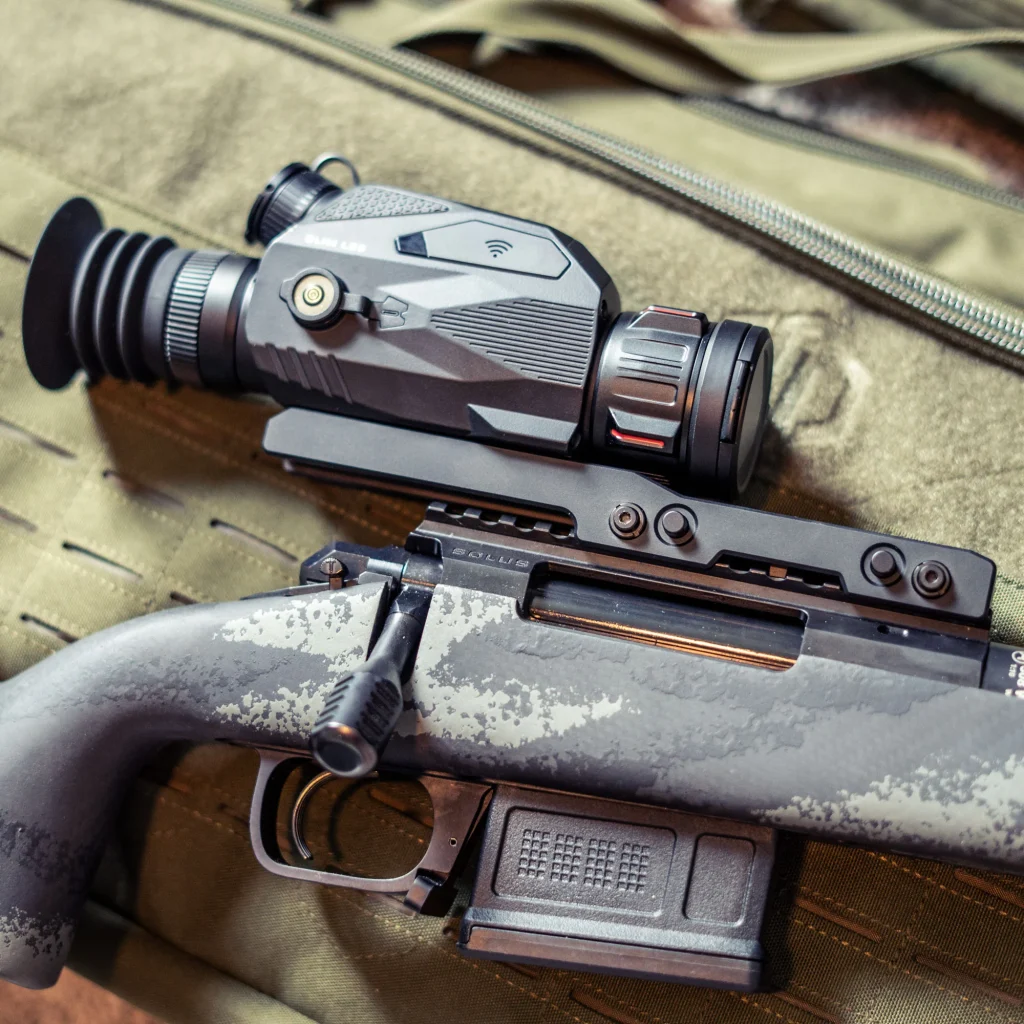
Comment vérifier la compatibilité entre une carabine et une lunette thermique ?
La compatibilité d'un montage pour lunette thermique dépend avant tout du fusil et du tireur. Le matériel peut être techniquement correct, mais ne pas convenir si la position de l'œil, l'espace sur le rail ou l'accès aux commandes ne sont pas optimaux.
Commencez par le rail ou le socle du fusil
Identifiez d'abord la surface de montage du fusil. Sur un fusil de type AR, il s'agit généralement d'un rail Picatinny supérieur. Sur un fusil à verrou, il peut s'agir d'un rail Picatinny, d'une embase de type Weaver ou d'embases séparées installées sur le boîtier de culasse.
Vérifiez ces détails :
- Le type de rail.
- La longueur du rail utilisable.
- Vérifier que le rail est de niveau et correctement installé.
- Vérifier si le rail comporte suffisamment d'encoches pour le support.
- Que le rail ou la base soit conçu pour résister au recul du fusil.
Une optique thermique peut être plus lourde qu'une optique diurne classique, surtout si elle est équipée d'un grand objectif, d'un télémètre laser intégré, d'un système d'alimentation par batterie et d'un boîtier métallique. Le montage et la base doivent pouvoir supporter ce poids et résister au recul.
Assurez-vous de la compatibilité de l'interface optique avant de choisir le matériel.
Ensuite, vérifiez l'optique elle-même. Les lunettes thermiques sont souvent regroupées dans une même catégorie, mais leurs interfaces de montage peuvent être très différentes. lunettes de visée thermiques Certains utilisent des systèmes de montage intégrés, tandis que d'autres peuvent nécessiter des rails, des supports ou des anneaux spécifiques.
Rechercher:
- Diamètre du tube, si des anneaux sont supportés.
- Embase Picatinny intégrée ou pied de montage.
- Support fourni ou support recommandé.
- Exigences spécifiques au modèle en matière d'adaptateur.
- Des remarques concernant la compatibilité régionale ?
Si une page produit indique seulement “ montage inclus ” sans plus de précisions, ne présumez pas qu'il est compatible avec toutes les carabines. Vérifiez le type de rail de votre carabine et demandez au revendeur ou au fabricant quel montage est inclus pour votre région.
Vérifiez la longueur du rail et la position de montage
La longueur du rail détermine l'emplacement de l'optique. On l'oublie facilement car les lunettes thermiques ont souvent des écrans, des oculaires, des compartiments à piles et des boutons de commande placés différemment des lunettes de jour.
Avant d'acheter, vérifiez où se trouvent les points de fixation du support sur le rail. Assurez-vous ensuite que cette position permette à l'oculaire d'être à une distance confortable de votre œil.
Sur les fusils de type AR, un montage déporté peut permettre d'avancer l'optique. Sur les fusils à verrou, le rail Picatinny du boîtier de culasse peut être plus court et la poignée d'armement peut limiter la position de l'optique. Si le système utilise un câble d'alimentation externe, il faut également prévoir l'espace nécessaire pour le passage de ce câble.
Réglez la hauteur du support pour un dégagement oculaire et un appui-joue optimaux.
La hauteur du montage détermine l'alignement naturel de votre œil avec l'écran. Une lunette thermique n'utilise pas de verre de la même manière qu'une lunette de visée diurne, mais la position de l'œil influe tout de même sur le confort, le champ de vision et la sécurité liée au recul.
Trop bas, et le tireur risque d'appuyer fortement sa joue contre la crosse ou de perdre le champ de vision. Trop haut, et la tête risque de dépasser de la crosse. Dans les deux cas, la position de tir est instable.
L'objectif est d'obtenir un appui-joue constant et stable, avec une visibilité optimale de l'optique. Si la carabine est équipée d'un appui-joue réglable, réglez-le après avoir choisi la hauteur de l'optique. Si la crosse est fixe, choisissez la hauteur de montage avec plus de soin.
Le dégagement oculaire est également important pour les carabines à percussion centrale. Une lunette thermique conçue avec un dégagement oculaire suffisant sur une carabine à faible recul peut sembler trop proche sur une carabine à cartouche plus lourde. Il faut toujours prévoir un dégagement suffisant pour le recul et les positions de tir.
Laissez l'accès aux batteries, aux ports, aux commandes et au LRF.
Un support ne doit pas obstruer les parties de l'optique utilisées pendant la chasse. C'est un problème courant sur les systèmes thermiques, car les compartiments de batterie, les ports de charge, les commandes de mise au point, les caches d'objectif et les modules LRF peuvent se trouver à proximité du support.
Avant d'acheter, vérifiez :
- Le compartiment de la batterie peut-il s'ouvrir lorsque le véhicule est installé ?
- Le port de chargement est-il accessible ?
- La bague de mise au point de l'objectif peut-elle se déplacer librement ?
- Tous les boutons sont-ils utilisables avec des gants ?
- Le support bloque-t-il le module de télémètre laser ?
- Le support gêne-t-il l'utilisation d'une bretelle, d'une poignée de culasse ou d'une poignée d'armement ?
Si votre équipement comprend une batterie externe, planifiez le cheminement des câbles avant votre première sortie de chasse. Un câble qui traverse la zone de tir, la zone de contrôle ou le point d'attache de la sangle peut rapidement devenir gênant.
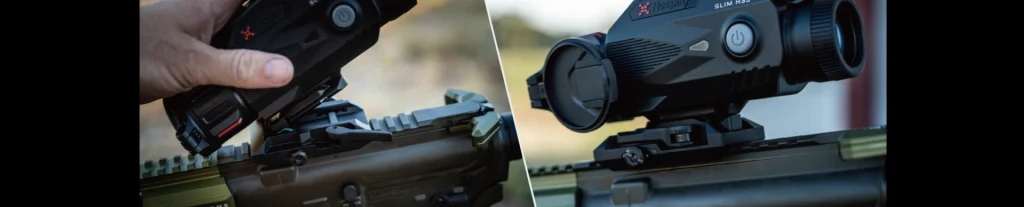
Quel type de montage convient à votre équipement de chasse ?
Le type de montage approprié dépend de l'utilisation prévue du fusil. Un fusil de chasse nocturne dédié, un système optique partagé, un fusil de type AR pour la chasse aux prédateurs et un système thermique longue portée plus lourd peuvent nécessiter des équipements différents.
Supports fixes pour fusils de vision nocturne dédiés
Un montage fixe est souvent la meilleure solution pour une carabine équipée de la même lunette thermique tout au long de la saison. Il simplifie l'installation et réduit le nombre de pièces mobiles.
Choisissez un support fixe lorsque :
- L'optique reste montée sur un seul fusil.
- Le fusil possède un étui adapté à l'optique montée.
- La reproductibilité est plus importante que la rapidité d'élimination.
- Le tireur n'a pas besoin de changer fréquemment d'optique.
Fixe ne signifie pas sans entretien. Le montage nécessite toujours un serrage correct, une vérification du zéro et des contrôles périodiques après le recul ou le transport.
Supports QD pour optiques partagées et transport
Les montages à démontage rapide sont judicieux lorsque l'optique doit être retirée du fusil. Cela peut se produire si le même viseur thermique est utilisé sur plusieurs fusils, si le fusil est transporté dans un étui compact ou si l'optique est retirée pour le rangement.
L'acheteur doit s'assurer d'un verrouillage fiable, d'un levier sécurisé et d'instructions d'installation claires. Le support doit exercer une pression ferme sans endommager le rail.
La règle principale est simple : le retour à zéro doit être vérifié, et non considéré comme acquis. Si l’optique est démontée puis remontée, vérifiez le zéro avant d’utiliser la carabine.
Supports en porte-à-faux pour fusils de type AR
Les montages cantilever sont courants sur les fusils de type AR car ils permettent de positionner l'optique vers l'avant tout en maintenant le montage fixé au rail du boîtier de culasse. Cela peut améliorer le dégagement oculaire et libérer de l'espace pour les poignées d'armement, les crosses ou les accessoires arrière.
N'utilisez un support déporté que s'il résout un réel problème de positionnement. Un décalage vers l'avant excessif n'est pas forcément un avantage. Un décalage trop important peut déséquilibrer la carabine vers l'avant ou éloigner l'écran inutilement.
Pour les lunettes thermiques de grande taille, vérifiez que le bras en porte-à-faux, le boîtier de l'objectif et les commandes disposent de suffisamment d'espace.
Utilisez uniquement des anneaux lorsque la lunette est conçue pour en recevoir.
N’achetez pas de colliers de montage pour lunette thermique, sauf si l’optique est conçue pour ce type de montage. Une lunette thermique tubulaire peut accepter des colliers, mais ce n’est pas le cas de nombreuses optiques thermiques.
Si les anneaux sont pris en charge, faites correspondre :
- Diamètre du tube.
- Hauteur de l'anneau.
- Interface ferroviaire.
- Espacement des anneaux.
- Niveau de recul.
Évitez de fixer des bagues de serrage sur des surfaces non prévues à cet effet. Les boîtiers thermiques peuvent contenir des capteurs, des composants électroniques, des batteries et des joints d'étanchéité. Un point de pression inapproprié risque d'endommager l'optique ou de provoquer des problèmes d'alignement.
Les lunettes thermiques plus lourdes nécessitent d'abord une stabilisation.
Les lunettes thermiques de grande taille nécessitent un montage stable avant toute fonctionnalité pratique. Les longs objectifs, les modules LRF intégrés, les batteries internes et les boîtiers métalliques peuvent alourdir l'arme. Ce poids, situé au-dessus du canon, est sensible au recul.
Pour les configurations plus lourdes, privilégiez :
- Forte implication du secteur ferroviaire.
- Un support de montage avec une surface de contact suffisante.
- Serrage correct des fixations.
- L'embase du fusil est bien installée.
- Une position équilibrée qui ne s'oppose pas au tireur.
Les fixations rapides, les supports en porte-à-faux et les anneaux peuvent encore convenir. L'important est de choisir le système qui assure le maintien de l'optique en cas de recul, et non pas seulement par commodité.
Que devez-vous vérifier après avoir installé un support pour lunette thermique ?
Après l'installation, vérifiez le montage avant de considérer le fusil comme prêt. Le test final ne consiste pas à vérifier l'alignement de l'optique sur un établi, mais à s'assurer que le fusil conserve son réglage et reste utilisable sur le terrain.
Serrer conformément aux spécifications du fabricant
Suivez scrupuleusement les instructions du fabricant du support et de l'optique concernant l'ordre de vissage et le couple de serrage. N'utilisez pas de valeurs de couple arbitraires. Un serrage insuffisant peut entraîner un déplacement du support. Un serrage excessif peut endommager la visserie, les rails ou l'optique.
Utilisez l'embout de vissage approprié, serrez uniformément et ne marquez les vis que si le fabricant ou l'armurier le recommande. En cas de doute, il est plus prudent de faire appel à un armurier qualifié.
Vérifier le dégagement oculaire et la position de l'image
Épaulez le fusil depuis les positions de chasse habituelles. Vérifiez l'ensemble du système de visée en position debout, assise, à genoux et en appui si ces positions font partie de votre chasse.
L'image doit apparaître sans que vous ayez à étirer le cou ni à relever la tête de la crosse. Si le fusil possède un appui-joue réglable, ajustez-le après le montage de l'optique.
Si le tireur ne connaît pas l'optique, un guide plus complet sur comment utiliser une lunette thermique peut aider à prendre de bonnes habitudes après le montage, notamment pour la mise au point, les palettes et les vérifications de base sur le terrain.
Réglez le fusil à zéro après l'installation du support.
Tout nouveau montage nécessite un nouveau réglage. Même si la lunette a déjà été réglée, le changement de montage peut modifier le point d'impact.
Utilisez la méthode de réglage du zéro de l'optique et une cible thermique appropriée. Si vous avez besoin d'un rappel, consultez ce guide sur comment régler une lunette thermique explique le processus de mise à zéro de base.
Revérifier après le recul, le transport ou le retrait
Vérifiez à nouveau le réglage du zéro après avoir tiré, transporté ou rangé la carabine avec l'optique montée. Revérifiez encore une fois si un montage QD a été démonté puis remonté.
Les signes avant-coureurs comprennent :
- Les groupes se déplacent après quelques tirs.
- Le levier de fixation semble plus lâche qu'avant.
- Les vis se déplacent de leur position initiale.
- La position de l'image optique change.
- Le fusil ne groupe plus les tirs là où on l'attend.
Si l'un de ces problèmes apparaît, cessez de le considérer comme un problème de réglage du zéro jusqu'à ce que le support et le rail soient vérifiés.
Dernière réflexion
Le choix d'un montage pour lunette thermique doit se faire dans le cadre du système de carabine complet, et non comme un accessoire séparé. Assurez-vous d'abord que le rail, l'interface optique, la hauteur, le dégagement oculaire, les commandes et la tolérance au recul soient compatibles avec vos besoins. Vérifiez ensuite le réglage initial avant la chasse.
Pour les utilisateurs de Nocpix, comparez les détails de l'optique et du montage sur la page produit, auprès de votre revendeur local ou via le support technique, puis utilisez où acheter si vous avez besoin d'une procédure d'achat spécifique à une région.
Questions fréquentes concernant les supports de lunettes thermiques
Tous les viseurs thermiques utilisent-ils des anneaux standard ?
Non. Certaines lunettes thermiques utilisent des anneaux, mais beaucoup utilisent des embases intégrées, des montages Picatinny, des sabots propriétaires ou des adaptateurs spécifiques au modèle. Vérifiez l'interface optique exacte avant d'acheter des anneaux.
Un montage Picatinny pour lunette thermique est-il compatible avec un rail Weaver ?
Parfois, mais pas toujours. Les rails Picatinny et Weaver se ressemblent, mais la largeur et l'espacement des fentes peuvent différer. Un support indiqué pour Picatinny uniquement ne doit pas être considéré comme compatible avec un rail Weaver.
Le support d'une lunette thermique doit-il être à démontage rapide ou fixe ?
Utilisez un montage fixe si la lunette thermique reste montée sur une seule carabine. Utilisez un montage à démontage rapide si le démontage, le transport ou le partage de l'optique font partie de la configuration. Dans tous les cas, vérifiez le réglage du zéro après l'installation et après le démontage.
Faut-il réinitialiser le zéro après avoir changé le montage d'une lunette thermique ?
Oui. Un changement de montage peut modifier le point d'impact. Réinitialisez la carabine après l'installation d'un nouveau montage et vérifiez à nouveau le réglage après le recul, le transport ou le retrait du système de fixation rapide.