







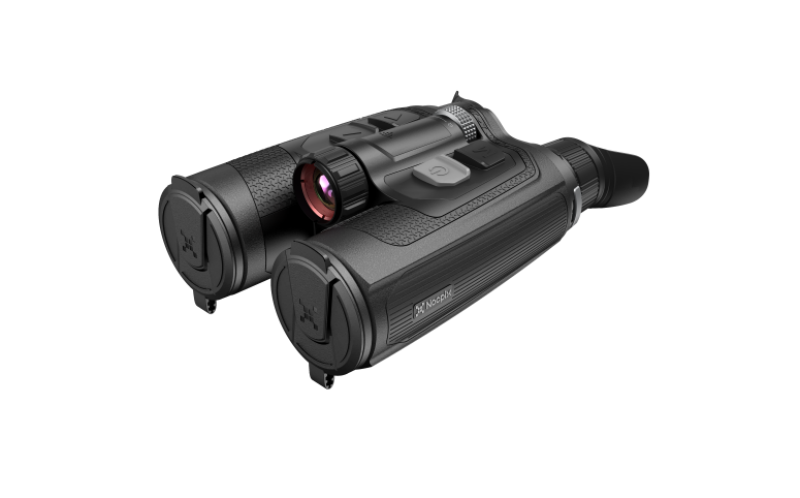
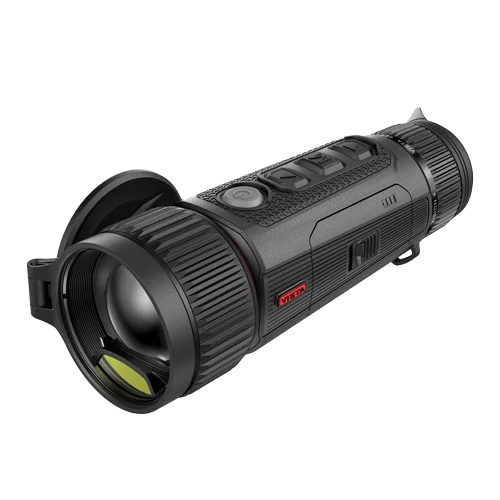
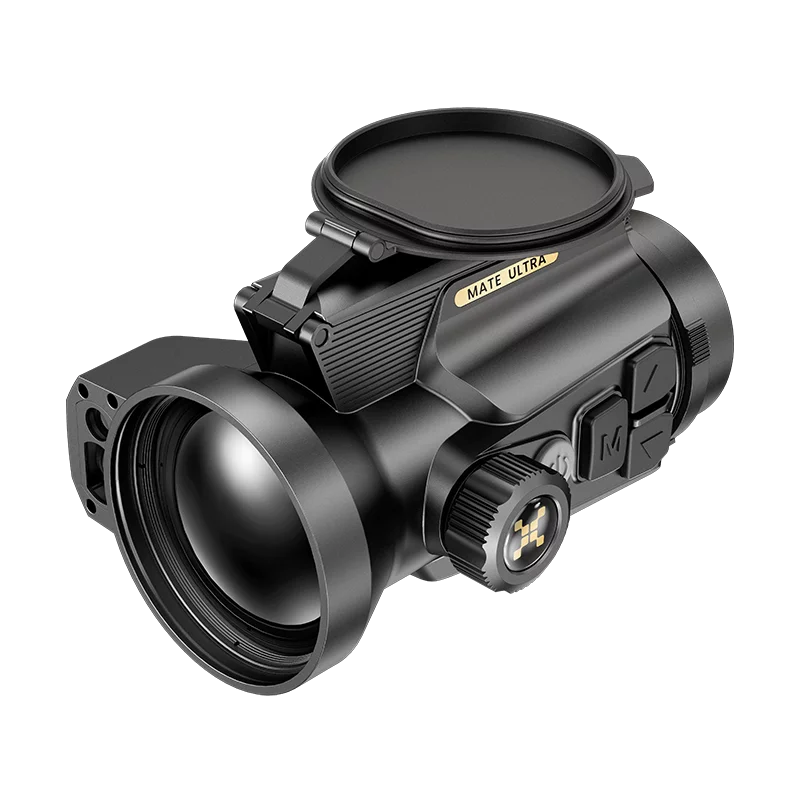
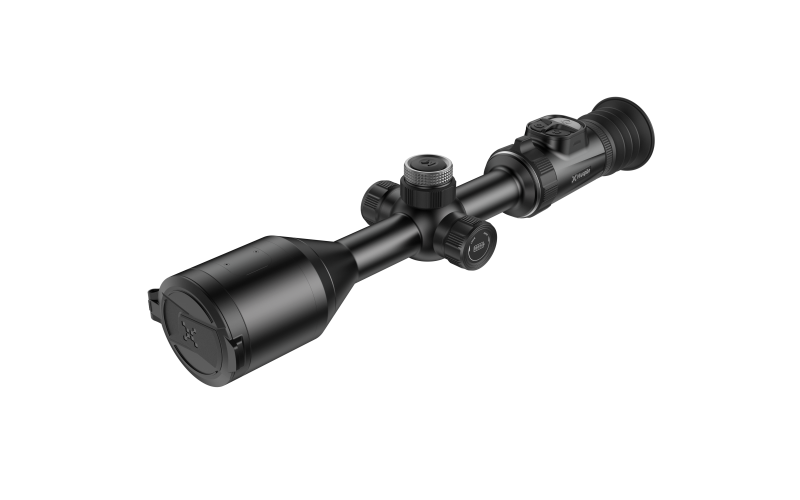


Which ACE 2 Fits Your Normal Hunt?
Choose H35R for closer work and frequent carrying. Choose H50R when longer field lanes make a larger starting view and finer distant detail more useful than a wide frame. Choose S60R when you want both distant detail and broad scene coverage, and can accommodate a heavier scope.
| Spesifikasjon | H35R | H50R | S60R |
|---|---|---|---|
| Detektoroppløsning | 640 × 512 | 640 × 512 | 1280 × 1024 |
| Objektivlinse | 35 mm F0.9 | 50 mm F0.9 | 60 mm F1.0 |
| Basic optical magnification | 2–4× | 3–6× | 2–4× |
| Maximum magnification, including electronic zoom | 32× | 40× | 48× |
| Field of view at 100 m (width × height) | 21.9 × 17.6 m | 15.4 × 12.3 m | 25.6 × 20.5 m |
| Scope weight | 850 g | 920 g | 980 g |
| Maximum runtime at 22°C | Up to 8 hours | Up to 8 hours | Up to 7 hours |
| Frame rate | 60 Hz | 60 Hz | 30/60 Hz |
All three use 12 μm pixels and have a noise-equivalent temperature difference (NETD) of ≤12 mK, a measure of thermal sensitivity. The shared R+ 2.0 thermal imaging system processes the captured image to reduce noise and enhance visible detail.
Okulær zoom 2.0 combines optical eyepiece magnification with electronic zoom. The table lists the optical range and the maximum combined magnification separately.
Start with the Part of the Hunt That Limits You
Think about where animals usually appear and what happens after you locate them. Along a nearby hedge, an animal can cross the view quickly. Across a large field, you may have time to hold it in view but struggle to distinguish its outline. The first situation puts more value on scene width; the second makes detail on the animal more useful.
Cover matters as much as distance. Short gaps between trees or crops leave less time to find the animal again when it reappears. A wider frame gives you more surrounding ground to stay oriented. Across an uninterrupted field, a tighter view may be easier to work with because the animal remains visible for longer.
Then consider how you carry and support the rifle. A scope that suits a tripod-based setup may feel different after a long walk between positions. Choose around the distances, views, and carrying conditions you encounter regularly, rather than the farthest animal you might occasionally see.
Choose H35R for Closer Work and Frequent Carrying
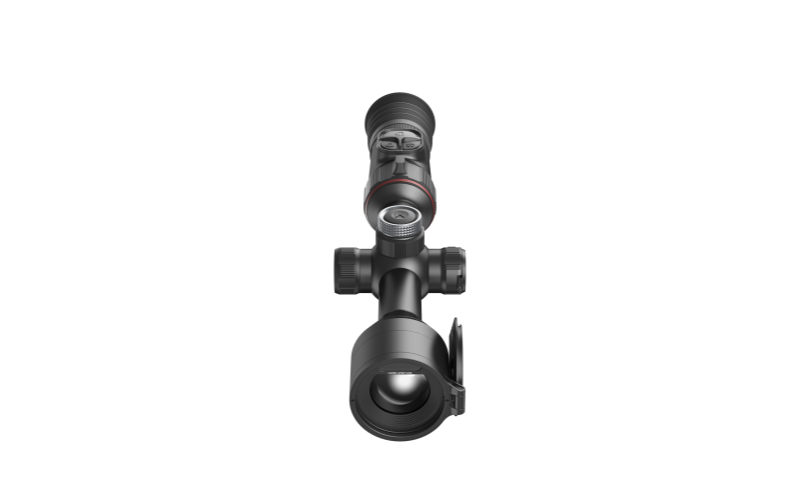
If most animals appear along nearby hedges, woodland edges, or short field lanes, H35R gives you more room to follow them than H50R. An animal moving through a gap in cover can travel farther across the frame before leaving the view. That makes scene width useful for closer boar or pest-control work where movement matters more than fine detail at distance.
H35R also puts the least weight on the rifle. For long walks between positions or a setup you carry more than you rest on a support, that may be the difference you use most often. S60R gives you an even wider view, but H35R combines a broader frame than H50R with a lighter setup.
The point to reconsider H35R is when distance becomes a regular obstacle. If an animal’s outline remains too small to examine comfortably, increasing zoom enlarges the image already captured. The longer lenses on H50R and S60R put more detector pixels across that animal in the first place.
Choose H50R for Longer Field Lanes
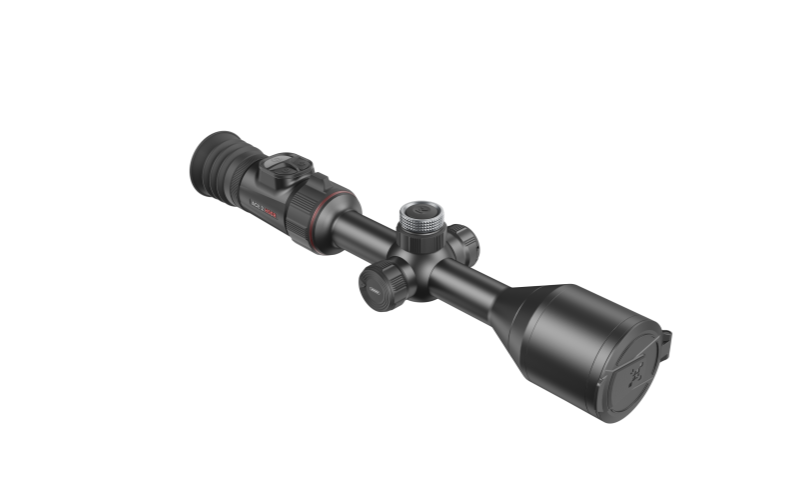
H50R suits ground where you can locate an animal and then spend time examining it across an open lane. Its higher starting magnification makes the animal appear larger, with less surrounding ground in the frame. This suits longer field lanes where you can hold an animal in view and examine its outline.
H35R and H50R share the same detector format. H50R’s longer lens places more pixels across the same animal at the same distance, but covers a narrower scene. This is the central 35mm vs 50mm thermal scope trade-off: more detail on a distant animal, or more room around it to follow movement.
In retailer Bristle Up’s H50R and S60R field comparison, Jesse Farr could clearly distinguish the dog’s head and legs through H50R at 200 m. For a rifle used along field edges and longer lanes, H50R offers that more focused view with less weight than S60R.
Its narrower frame is worth trying on the closest part of your ground, too. If you can keep an animal comfortably in view there, the extra emphasis on distant detail may suit the rest of your hunting well. If you repeatedly have to move the rifle to recover nearby movement, one of the wider-view models may be a better fit.
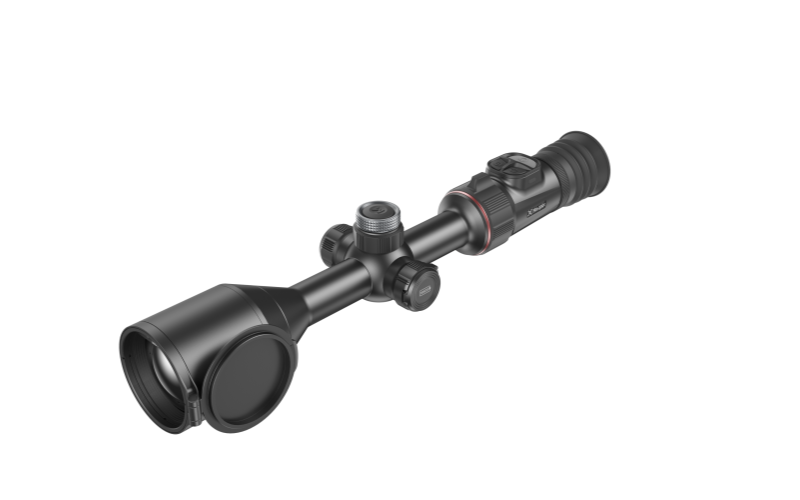
Choose S60R for Distant Detail and Wide Scene Coverage
S60R is useful across open ground when you want to examine a distant animal while keeping field edges and surrounding terrain in view. Its wider field also gives moving animals more room in the frame.
It combines a physically larger detector with a longer lens. Its 1280×1024 detector provides four times the total pixel count of the 640×512 sensors. Combined with the 60 mm lens, it delivers the widest field of view in the ACE 2 range while retaining more detector pixels across the same target. Thermal sensor resolution, pixel pitch, and focal length work together to give S60R both broad coverage and fine detail.
This also explains why H50R can make an animal look larger at starting magnification while S60R captures more detail on it. The apparent size of the animal depends on how the image is displayed and magnified. Optical eyepiece magnification enlarges that displayed image; it does not increase the number of detector pixels covering the animal.
In Bristle Up’s comparison, S60R preserved the dog’s outline more clearly than H50R at 300 m.
In ShootingUK’s ACE 2 S60R field review, Ed Jackson described detailed views of deer and surrounding farmland during several September evenings. For open-field use, S60R lets you examine the animal while keeping the surrounding terrain in view.
If you usually shoot from a tripod or high seat, S60R’s extra weight matters less than on a rifle carried between positions. On a setup carried through closer terrain, H35R’s lower weight may matter more often. S60R offers up to seven hours of runtime at 22°C, compared with up to eight hours for H35R and H50R at the same temperature.
Make the Final Choice on Your Ground
If your use falls between two models, compare them on the part of the hunt that gives you the most trouble: keeping an animal in frame, seeing its outline at distance, or carrying the rifle comfortably. The broader thermal scope buying guide covers other features and equipment roles that may affect your setup. Explore Nocpix ACE 2 thermal riflescopes for the full feature set, and check local prices, availability, and warranty terms before choosing.